Compare PAC donor lists to refuse corporate-backed candidates
Every election cycle, a fresh wave of candidates stamps "No Corporate PAC Money" across their fundraising emails like a badge of moral clarity. Over 170 members of the current Congress have signed the pledge tracked by End Citizens United. It sounds clean.
Harrison Lockwood, Lead Columnist on Systemic Justice & Climate Action·Updated: June 26, 2026·10 min read
The $5,000 Lie: Why "No Corporate PAC" Pledges Won't Save Your Democracy
Here is the material reality: Corporate PACs — technically called Separate Segregated Funds — can only donate $5,000 per candidate per election. That's the legal ceiling. Five thousand dollars. For a congressional race that now routinely costs north of two million, that $5,000 is pocket lint. The real leverage lives elsewhere — in bundled individual checks maxed out at $3,300 a pop from executives and board members, in six-figure Super PAC ad buys that campaigns "can't coordinate with" (wink), and in the black hole of 501(c)(4) dark money groups that never have to disclose a single donor. Saying "No Corporate PAC" without scrutinizing the rest of a candidate's FEC filings is like locking the front door and leaving every window wide open.
The pledge to refuse corporate PAC money is a permission structure for voter complacency — it lets you stop digging at exactly the moment you should start.
Navigating FEC Form 3 to Uncover What a Candidate Actually Raised
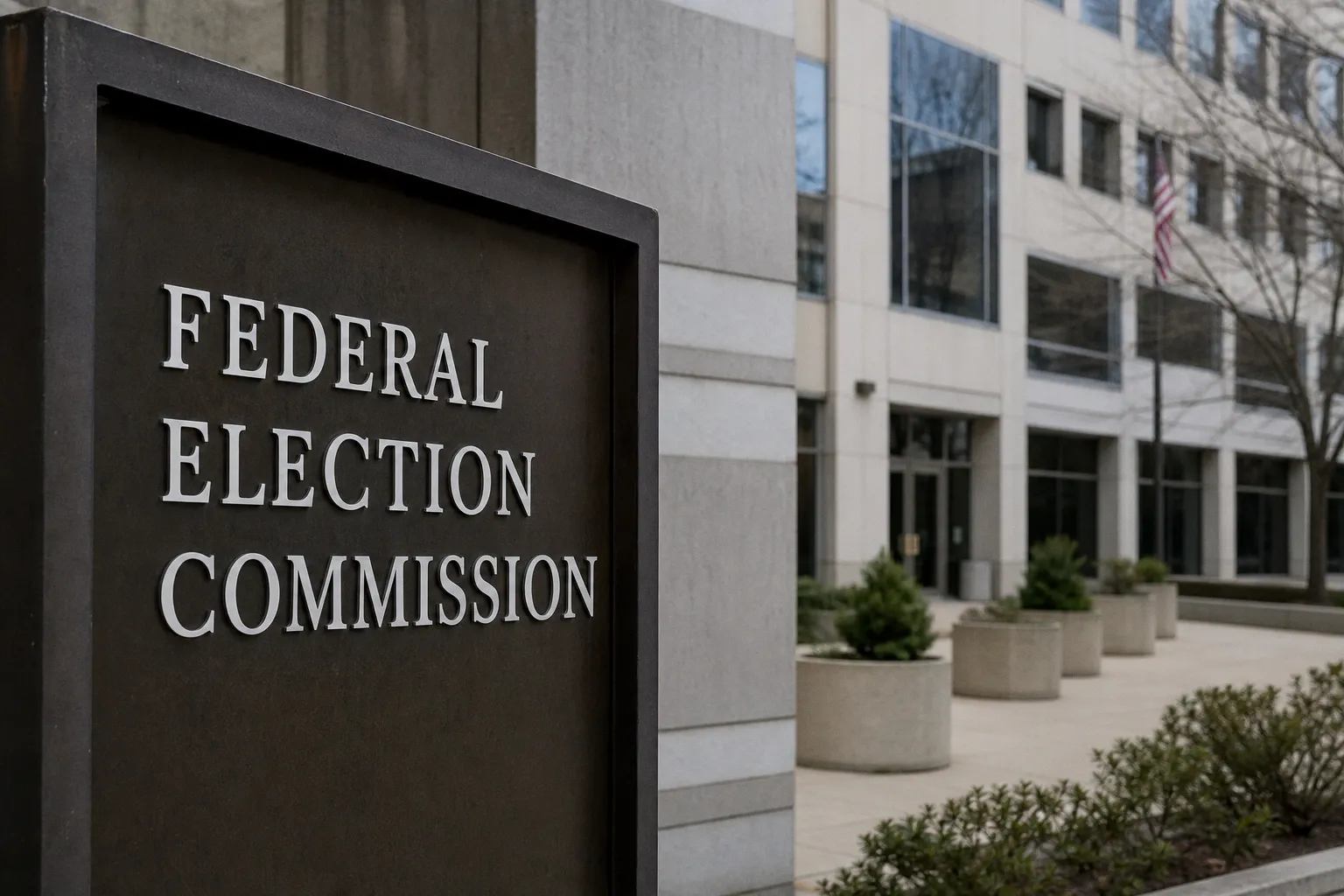
Every House and Senate campaign must file Form 3 with the Federal Election Commission, detailing all receipts and disbursements. These quarterly reports — due on the 15th or 20th of the month following each quarter's close — are the raw material of accountability. The FEC maintains a searchable database of every committee profile and candidate report, and every donation over $200 is itemized: the donor's name, employer, occupation, and the exact amount.
This is not abstract. If a candidate running on a "people-powered" platform lists a parade of $3,300 contributions from vice presidents at pharmaceutical companies, partner-level attorneys at fossil fuel firms, and C-suite executives at defense contractors, that tells you something no pledge can erase. The individual contribution limit sits at $3,300 per election for the 2023–2024 cycle, but a motivated bundler — a corporate executive who hosts a private fundraiser and collects a stack of maxed-out checks from colleagues — can deliver $33,000 or $66,000 in a single evening without a single dollar flowing through a PAC. That bundling dynamic is the system's open secret, and FEC filings are where the fingerprints show up.
Start with the FEC's own site. Pull the candidate's committee profile. Look at the "Receipts" section of their Form 3. You're scanning for two things: the concentration of maximum individual contributions from a single industry, and any direct transfers from Separate Segregated Funds. The first tells you who has leverage over the candidate's material conditions; the second is the PAC money they may or may not be refusing.
Distinguishing Grassroots Support From Corporate-Adjacent Cash
A campaign that brags about its average donation being $27 is performing a sleight of hand if it also quietly hauls in maxed-out executive checks. The average donation is a useless metric when the distribution is bimodal: thousands of small-dollar gifts from actual constituents, and a smaller cluster of $3,300 contributions from people whose LinkedIn bios list them as Senior Vice President of Regulatory Affairs at Dow Chemical. The average lands somewhere in the middle. The power dynamic does not.
Here's how you separate the signal from the noise:
1. Pull the itemized individual contributions from Form 3. Filter by employer. If you see the same corporation or industry cluster appearing repeatedly, that's not coincidence — it's coordinated extraction.
2. Cross-reference with the candidate's "No Corporate PAC" claim. The pledge only covers Separate Segregated Funds. It says nothing about individual contributions from corporate executives, which are legally distinct and often strategically larger.
3. Check the occupation and employer fields. FEC requires donors over $200 to list both. Vague entries like "self-employed" or "investor" paired with a maxed-out check deserve scrutiny — they often conceal corporate wealth behind benign language.
4. Look at the timing. A cluster of maxed-out donations from the same industry in a single filing period signals a coordinated bundling event, not organic grassroots enthusiasm.
A $3,300 check from a pharmaceutical CEO and a $3,300 check from a retired teacher arrive on the same FEC form — but they carry radically different leverage over what a legislator does once sworn in.
Mapping Industry Influence With OpenSecrets' Top Contributor Data
OpenSecrets aggregates FEC filings and categorizes every candidate's "Top Contributors" by industry sector — Oil & Gas, Pharmaceuticals, Wall Street, Defense, Big Tech. This is where the structural analysis gets precise. You don't have to guess which extraction industry has its hand on a candidate's shoulder; OpenSecrets has already done the arithmetic.
A candidate who refuses corporate PAC money but draws heavily from the individual donor networks of a single industry is not independent. They are structurally captured in a way that is, in some respects, more insidious than taking a PAC check — because the arrangement leaves no paper trail that says "corporate donation." It says "individual contribution." The complicity is laundered through the fiction that a person and their employer are unrelated entities, as though a hedge fund partner's political donations exist in a vacuum disconnected from the material interests of the fund.
This is the gap the "No Corporate PAC" pledge exploits. It addresses the most visible, most legible form of corporate influence — the PAC — while leaving the deeper structures untouched. And it works precisely because most voters will read the pledge and stop there. They won't pull the OpenSecrets page. They won't scan the Top Industries chart. They won't notice that the candidate's second-largest industry contributor is the very sector they claim to be fighting.
The Dark Money Void: 501(c)(4) Groups and What You Can't See
The most corrosive form of corporate influence in American elections is the one you literally cannot trace. Under section 501(c)(4) of the tax code, organizations classified as "social welfare" groups can spend unlimited sums on political activity without disclosing their donors. These dark money organizations can run attack ads, fund mailers, and saturate digital platforms with targeted messaging — and the voters receiving that messaging will never know who paid for it.
This is not a loophole. It is the architecture. The Citizens United decision in 2010 blew open the door for unlimited corporate spending on elections, and the 501(c)(4) structure provided the darkened hallway behind it. A fossil fuel conglomerate can funnel money through a 501(c)(4) called something like "Americans for Energy Prosperity," and that group can spend millions supporting or opposing candidates without the conglomerate's name appearing anywhere a voter would ever look.
You cannot audit what is not disclosed. That is the structural problem. But you can note the existence and activity of dark money groups operating in a given race. If a candidate claims independence from corporate interests while a 501(c)(4) with ties to their policy positions is running a $2 million ad campaign on their behalf, the "independence" is a legal fiction. Super PACs at least disclose their donors — 501(c)(4) groups do not. And while Super PACs are legally barred from coordinating directly with a candidate's campaign, the revolving door of consultants and shared data vendors makes that prohibition functionally meaningless.
The unknowns here are not trivial. We do not know the exact identities of donors behind most dark money operations. We do not know the degree of strategic coordination between ostensibly independent expenditure groups and the campaigns they benefit. What we do know is the structural incentive: anonymity enables extraction without accountability, and the current disclosure regime was designed to permit exactly that.
Late-Cycle Money: The 48-Hour Notices That Reveal Last-Minute Deals
FEC rules require campaigns to file 48-hour notices for any contribution of $1,000 or more received in the final stretch before an election. These notices are public, and they are revealing. A candidate who has spent the entire cycle cultivating a grassroots image might suddenly show a flurry of maxed-out checks from corporate executives in the last two weeks before Election Day — precisely the window when media scrutiny drops and voter attention narrows to horse-race polling.
This is not accidental. Late-cycle bundling is a strategic maneuver. By the time these 48-hour notices hit the FEC database, most voters have already made their decisions. The disclosures exist in a technical sense — they are public records — but they functionally operate in darkness. A dedicated auditor can pull them. A casual voter checking the candidate's website will see only the curated narrative of small-dollar enthusiasm.
The structural critique here extends beyond individual races. The entire disclosure timeline is designed to create information asymmetry. Candidates file quarterly reports with weeks of lag between donation and publication. The 48-hour notices narrow that window for large late contributions but only apply in the immediate pre-election period. For the rest of the cycle, the money flows in near-real-time while the accountability mechanism operates on a delay. The system is not broken. It is performing exactly as those who benefit from opacity designed it to perform.
State-Level Races: Where Corporate Capture Is Cheapest and Most Complete
Federal elections get the headlines, but the most efficient corporate leverage operates at the state level. Governors, state legislators, and judges wield enormous power over environmental regulation, labor law, voting access, and public education funding — and their campaigns cost a fraction of a congressional race. A $50,000 investment in a state legislative race can yield policy returns worth hundreds of millions to the donor's industry.
FollowTheMoney.org, now operated by OpenSecrets, is the primary tool for tracking corporate donor influence in state elections. The database covers gubernatorial and state legislative races, and the picture it paints is damning. In state after state, the same corporate interests that lobby Congress are spending proportionally far more to capture statehouses — because the return on investment is higher and the scrutiny is lower. A pharmaceutical company that would face a headline for dumping $500,000 into a Senate race can spread that same amount across twenty state legislative races with virtually no media coverage.
This is where the extraction economy concentrates its most cost-effective leverage. And it is where voter auditing matters most, because state-level candidates are far less likely to face the kind of investigative scrutiny that occasionally catches federal-level corruption. The tools exist. The filings are public. The data is aggregated. What is missing is the political will among voters to treat a state legislative race with the same forensic attention they might — might — bring to a presidential primary.
What Real Accountability Requires
The "No Corporate PAC" pledge is not worthless. It eliminates one vector of influence. But treating it as sufficient is an act of willful ignorance, and in a political system where corporate extraction has been constitutionally sanctified since 2010, willful ignorance is complicity.
Real accountability requires sustained material analysis. It requires pulling FEC Form 3 filings, cross-referencing OpenSecrets industry totals, monitoring 48-hour notices, and tracking the dark money ecosystem that operates in permanent shadow. It requires understanding that a $3,300 individual contribution from a corporate executive is functionally a corporate contribution, regardless of what the legal fiction demands we call it. And it requires accepting that the system of campaign finance disclosure in the United States was not designed to empower voters — it was designed to create the appearance of transparency while preserving the structures of extraction.
We can demand more. We can refuse to accept the pledge as the end of the conversation. We can audit the money, name the industries, and trace the leverage. The tools are public. The data is there. The only thing the extraction economy counts on is that we won't bother to look.