Change your gender marker on a Texas ID: my experience
A Texas driver's license does not reflect who you are. It reflects what the state permits you to be. To change the gender marker on that card, you cannot walk into a driver license office, declare your identity, and walk out with an accurate record.
Harrison Lockwood, Lead Columnist on Systemic Justice & Climate Action·Updated: June 14, 2026·10 min read
Change your gender marker on a Texas ID: my experience
I learned this the way most of us do: by discovering that the paperwork required to affirm my own identity depends on the discretion of a system designed to make the process difficult. This is not a procedural footnote. It is the architecture of a state government that has decided bureaucratic friction is an acceptable price for policing who gets to exist on their own terms.
A court order is the toll. Texas collects it from every trans resident who wants their ID to match their life.
The legal threshold: why a court order, and why now
The requirement sits in statute. Under Texas Health and Safety Code Section 192.011, a birth certificate may be amended to reflect a change of sex only upon the receipt of a court order. The Texas Department of Public Safety, which issues driver's licenses and state identification cards, mirrors that requirement at the counter. Bring anything less than a certified order, and the clerk will return your paperwork unprocessed. Texas does not currently allow for a gender marker change on identity documents based on self-attestation or a physician's letter. The court order is mandatory, and the legislature has shown no interest in revisiting the mandate.
Texas is not the only state with a judicial process, but it is notable for refusing the lower-friction alternatives that other states have adopted. A growing number of jurisdictions permit a gender marker update on the basis of a sworn statement from the applicant, sometimes paired with a letter from a licensed medical provider. Texas accepts neither. The state has chosen the most administratively burdensome path, and the result is a process that scales directly with the resources of the person attempting it. Those with money hire attorneys. Those without wait, refile, and wait again.
The structural logic is not complicated. A court order requires a petition, and in many counties a hearing. That hearing is conducted by a judge operating within a local legal culture, a county's political composition, and the backlog of similar requests already on the docket. The system converts a question of identity into a question of access: access to legal counsel, access to time off work, access to a courthouse that will treat the petition as routine rather than as an occasion for scrutiny. Every additional hoop is a filter, and the filter sorts petitioners by class.
Securing the judicial mandate: county-level discretion
Here is where the official record ends and the lived experience begins. The Texas statutes do not specify how long a court must take to grant an order, what evidence is required beyond the petition, or whether a judge may demand additional documentation before signing. Processing times vary significantly by county. So does the willingness of individual judges to grant the order at all.
In practice, a petitioner files a petition for a change of sex in the district court of their county of residence. The petition typically includes identifying information, the requested change, and supporting documentation. Many attorneys recommend including a letter from a physician confirming the petitioner's gender identity — not because the statute requires it, but because it greases the discretionary machinery. Some judges grant orders as a matter of course, treating the petition like any other administrative filing. Others schedule hearings. Some interrogate the petitioner about their medical history, their identity, their sincerity. Some refuse outright.
This variation is not a malfunction. It is the system operating as designed. Judicial discretion, exercised unevenly across 254 counties, produces radically different outcomes for petitioners who are, in material terms, asking the state for the same thing. A trans person in Travis County and a trans person in a rural East Texas county are governed by the same statute, but they are navigating entirely different procedural realities. The state has externalized the cost of its policy to the local bench, and the bench has externalized the cost of its discretion to the petitioner.
I will not pretend the process was simple. I will not pretend the cost was negligible. What I will say is this: the court order exists, it can be obtained, and obtaining it is the first move in a longer sequence the state has designed to be exhausting by design.
Amending vital records: the foundation under everything else
The court order is the key that unlocks the birth certificate. Texas Health and Safety Code Section 192.011 governs the amendment of a birth certificate to reflect a change of sex, and it requires the same order that the DPS demands for the driver's license. This is not redundancy. It is sequencing. The state treats the birth certificate as the foundational vital record, and the driver's license, passport, Social Security record, and most other identity documents derive their accuracy from it.
The practical consequence is that the court order functions as a single bottleneck through which a cascade of administrative updates must flow. Once the order is granted, the birth certificate can be amended through the Texas Department of State Health Services. The amended certificate then travels to the Social Security Administration, to the DPS for the driver's license, to employers, to banks, to insurance carriers, to schools. Every step depends on the order. Every step introduces its own delay, its own fee, its own opportunity for a clerk to require a second look. For those of us managing this cascade, the material conditions are not abstractions. They are the filing fee, the missed shift, the day spent in a government office, the letter from a doctor that costs more than the appointment that produced it. The state has converted a question of identity into a question of capital, and capital is what the petitioner must bring. For readers navigating the broader administrative and civic updates that follow a name or gender change — and the practical advice that surrounds them — broader resources exist at nevlanews.com.
The in-person gauntlet: what actually happens at the DPS
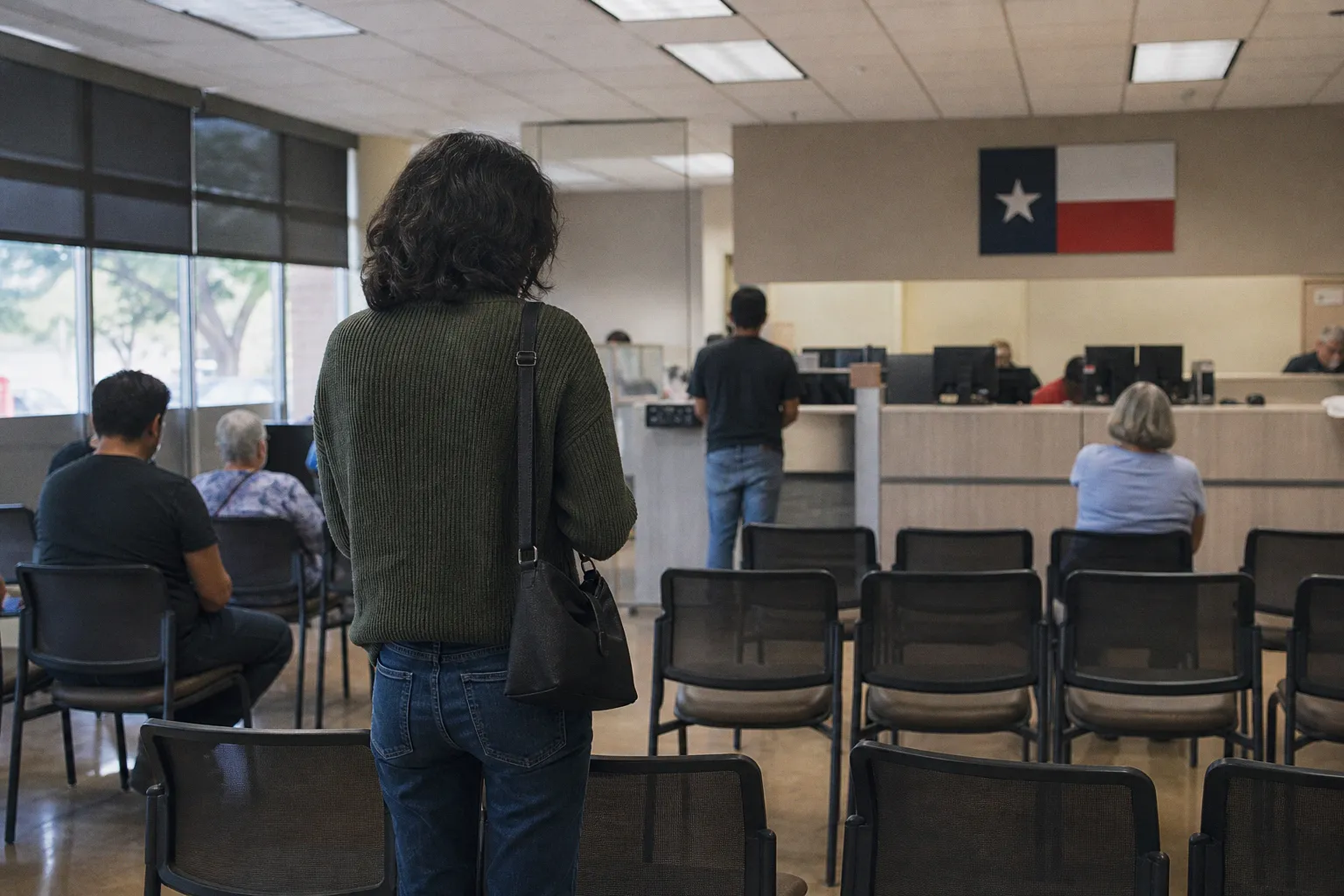
Once the court order is in hand and the birth certificate has been amended, the final administrative step is the visit to a DPS office. This is not optional. The Texas Department of Public Safety requires the applicant to appear in person. There is no online portal for a marker change, no mail-in amendment, no appointment that allows submission of the court order by courier or email.
The visit itself is, in most cases, a transaction. The applicant should expect to present:
- The certified court order reflecting the change of sex
- The current Texas driver's license or ID card
- The amended birth certificate (if the marker on the existing license is being changed)
- Proof of identity and residency, as required for any DPS transaction
- Payment for the standard license or ID fee
Present the documents. Sit for a new photo. Walk out with a temporary license and, within a few weeks, a permanent card that reflects the corrected marker.
But the transaction carries weight that exceeds its paperwork. You are asking a state agency to update a government record on the basis of a court order issued because the state, through its legislature, declined to accept your word. The clerk behind the counter is processing the outcome of a process that exists specifically because the state does not trust you to know your own gender. The new card is accurate. The process that produced it is not.
Some offices process the change without incident. Some do not. Reports from trans Texans across the state describe inconsistent treatment at the counter: clerks who have never seen a court order for this purpose, clerks who require additional documentation not listed in the official guidance, clerks who treat the request as routine and clerks who treat it as an event. The state has built a system that depends on the training, discretion, and disposition of individual employees, and the result is the same lottery that defines the court process — reproduced at the final administrative step.
The card I now carry is accurate. The path to it was a gauntlet designed to be survived, not navigated.
Systemic barriers: the real cost of the requirement
The court order requirement is not a neutral procedural choice. It is a material barrier that sorts trans Texans by access to legal resources, by geography, by the politics of their local bench, and by their ability to absorb the financial cost of an extended legal process. A petitioner with a private attorney and a flexible employer moves through the system in weeks. A petitioner without either waits months — and in some counties, never receives the order at all.
Consider what the state requires against what it could require. A self-attestation model eliminates the court order entirely. A physician's letter model eliminates the petition, the hearing, the filing fee, the attorney's fee, and the months of waiting. Texas has chosen neither. It has chosen the path that maximizes friction, and it has left the friction to be absorbed by the people least equipped to bear it.
| Requirement | Texas (current) | Self-attestation model | Physician's letter model |
|---|---|---|---|
| Court order | Mandatory | Not required | Not required |
| Physician's letter | Optional but commonly attached | Not required | Required |
| In-person DPS visit | Mandatory | Varies by state | Varies by state |
| Estimated time to completion | Months | Days to weeks | Weeks |
| Estimated out-of-pocket cost | $500–$2,000+ | Minimal | $100–$300 |
| County-level variation in outcome | High | Low | Moderate |
The table is not a comprehensive policy analysis. It is a description of what the choice looks like in material terms for the person living through it. Texas has selected the column with the highest cost, the longest timeline, and the greatest dependence on discretionary decision-making by officials at every step. It has done so knowing exactly who pays that cost: trans Texans without attorneys, trans Texans in conservative counties, trans Texans who cannot take a day off work to stand in a government queue, trans Texans whose judges have decided that their identity is not theirs to declare.
The position this puts us in
I have the order. I have the amended birth certificate. I have the new license. The card I carry now matches the person who has always existed, and the relief of that is not small. But I am writing this not because the process worked, but because the process is the point. Every petitioner who navigates it successfully does so in spite of the architecture, not because of it. The architecture is the policy. The friction is the design. The cost is extracted from trans Texans in the form of money, time, and the quiet humiliation of asking a judge to affirm what should never have required affirmation.
We do not need another study. We do not need a commission. We need the repeal of the court order requirement, the acceptance of self-attestation, and the recognition that the state's insistence on judicial review of identity is itself the discrimination. The court order is not a safeguard. It is a toll booth, and it is past time the state stopped collecting.