Compare gig delivery mileage rates to find your true pay
The IRS standard mileage rate for business driving is 67 cents per mile in 2026. That number looks clean, official, and deceptively final. Gig delivery platforms benefit from that neatness.
Harrison Lockwood, Lead Columnist on Systemic Justice & Climate Action·Updated: June 30, 2026·16 min read
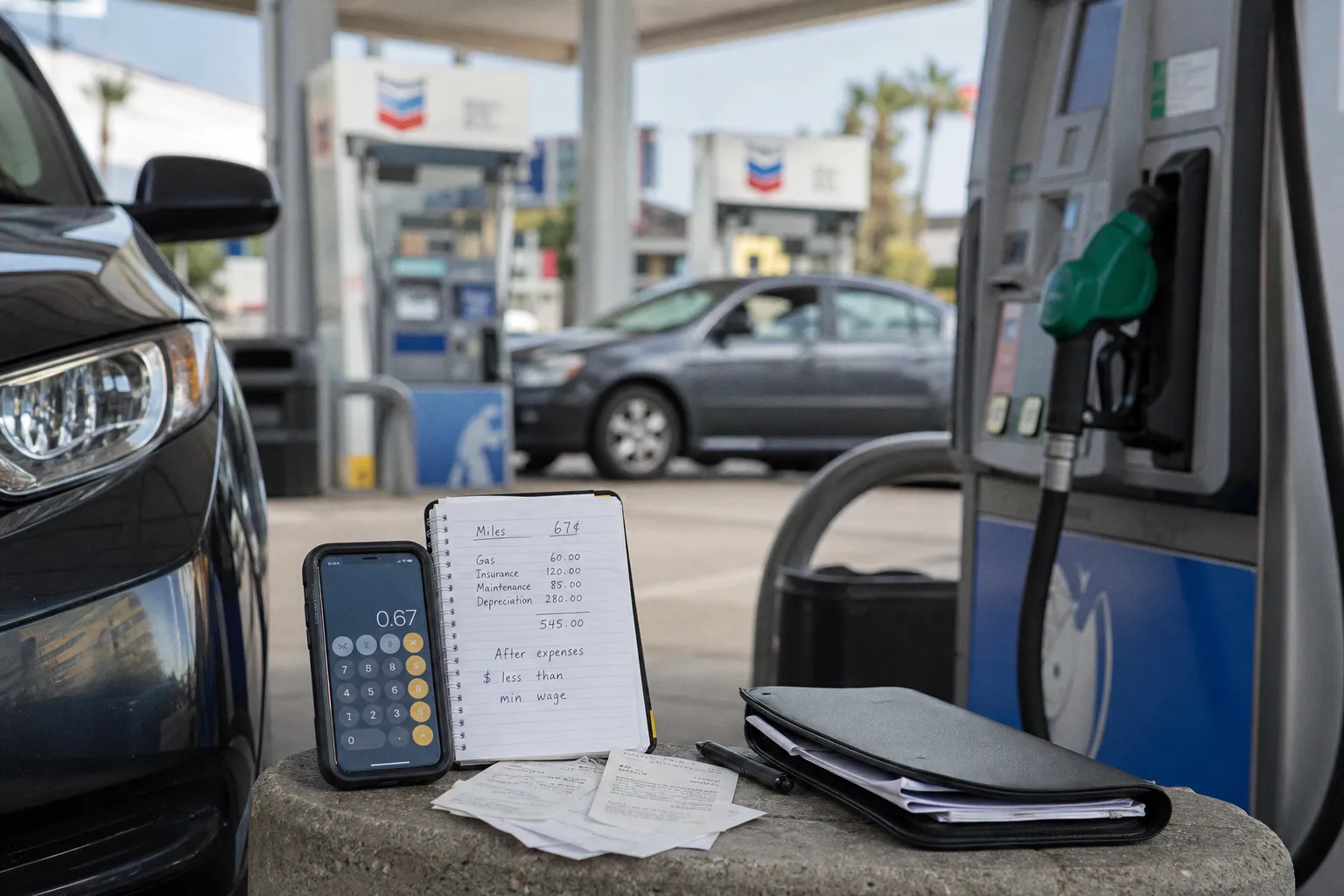
If you want to know how to check compare gig delivery mileage rates to find your real pay, start with the basic fraud of the frame: mileage is not a side detail. It is the wage floor hiding under the wage offer. Every mile driven for a delivery app transfers cost from the platform to the worker — fuel, tires, brakes, oil, insurance risk, depreciation, deadhead miles, waiting time, and the slow destruction of the vehicle that makes the job possible.
That is not an accounting quibble. It is the business model.
The IRS mileage rate is not your profit calculator
The 67-cents-per-mile IRS rate matters because it gives workers a reference point. It also gets misused constantly. The rate is a tax deduction estimate, not a moral certificate proving that a delivery offer pays enough. It does not guarantee that your actual costs equal 67 cents. For high-mileage gig workers, actual costs can climb past that benchmark depending on vehicle age, financing, local repair prices, insurance, fuel efficiency, road conditions, and the brutal rhythm of stop-and-go delivery work.
Platforms prefer the confusion. They display gross pay because gross pay flatters them. A $9 delivery looks tolerable if the app says it takes 25 minutes and 6 miles. But that number usually fails to include the trip back to a busier zone, the unpaid wait outside a restaurant, the time spent rejecting insulting offers, or the maintenance bill arriving three weeks later like a second boss collecting tribute.
The IRS number can help you build a conservative baseline. It cannot replace your own ledger.
Let’s make the arithmetic plain. If a platform offers $8.50 for a delivery requiring 10 total miles — including the return mileage you actually drive — the IRS-rate expense estimate alone comes to $6.70. That leaves $1.80 before self-employment tax, unpaid wait time, parking, tolls, and the risk that the order takes 35 minutes instead of 18. This is how a job that looks “above minimum wage” in the app becomes sub-minimum work in material reality.
Gross pay is the platform’s story. Net pay is the worker’s evidence.
The IRS rate is still useful because it gives workers a blunt question to ask every offer: does this delivery clear the cost of using my car before I even begin to count my labor? If the answer is no, the platform is not paying you to work. It is renting your vehicle at a discount and calling the residue income.
Depreciation is the quiet pay cut
Gas gets the attention because workers buy it visibly. Depreciation does the deeper damage because it accumulates silently. The car loses value with every mile, every pothole, every hard stop, every urban delivery loop where the vehicle works like commercial equipment while the owner gets treated as a casual hobbyist.
Depreciation often accounts for the largest portion of total vehicle ownership cost. That matters because many gig workers calculate earnings as:
Pay minus gas equals profit.
That formula serves the companies beautifully. It ignores the largest slow-moving cost on the worker’s side of the ledger.
A platform does not buy your tires. It does not replace your transmission. It does not absorb the lower resale value after you add 25,000 delivery miles in a year. It does not carry the financing risk if your car becomes worth less than the loan balance. It does not contribute to payroll taxes when it classifies you as an independent contractor. It externalizes the entire machine and then prices the labor as if the machine came from nowhere.
A useful delivery calculation includes at least these categories:
1. Fuel for all miles driven, not just “active” miles.
If the app counts only pickup-to-dropoff mileage, it has already narrowed the truth. You drove to the restaurant. You may drive back to a viable zone. You may circle for parking. The engine does not care whether the app labels the mile productive.
2. Depreciation across delivery mileage.
Estimate the difference in your vehicle’s value over time, especially if you drive high mileage. Older cars may depreciate differently than newer ones, but they do not become free to operate. They often trade depreciation for repairs.
3. Maintenance and wear items.
Oil changes, brakes, tires, suspension, batteries, fluids, wipers, alignments — delivery work eats these faster than ordinary commuting. Stop-and-go driving is not gentle.
4. Insurance costs and risk exposure.
Some personal policies do not cover commercial-style app work cleanly. If you need additional coverage, that belongs in the cost column. If you skip it because the margin is too thin, the platform has pushed risk onto you.
5. Self-employment tax burden.
Independent contractors carry payroll tax obligations that employers would otherwise partly cover. The company’s “savings” become the worker’s bill.
6. Unpaid time.
Waiting for orders, waiting at restaurants, resolving app glitches, driving to demand zones, and sitting through algorithmic dead space all reduce hourly pay. The clock does not stop merely because the company refuses to count it.
This is not pessimism. It is arithmetic with the corporate varnish stripped off.
A better way to compare gig delivery mileage rates
The phrase “mileage rate” can mean several things, and platforms exploit that ambiguity. A worker may ask, “What does this app pay per mile?” But the app may not provide a stable per-mile rate at all. It may use opaque algorithmic pricing based on estimated time, distance, demand, customer tip, merchant delays, and whatever internal incentives the company refuses to disclose.
So the worker has to reverse-engineer the rate. Not because workers love spreadsheets. Because the platform withholds clarity.
Here is a practical comparison framework:
| Measure | What the platform wants you to notice | What you should calculate |
|---|---|---|
| Gross pay per order | The full payout shown on screen | Payout minus vehicle cost for total miles |
| App-listed mileage | Usually pickup and dropoff distance | All miles from acceptance to next viable earning position |
| Time estimate | Optimistic route and pickup assumptions | Actual time from acceptance through return/reset |
| Pay per active hour | Earnings while actively delivering | Earnings across active time plus waiting and repositioning |
| Vehicle cost | Often ignored or reduced to gas | Fuel, depreciation, maintenance, insurance, and fees |
| Tax burden | Treated as the worker’s problem | Self-employment tax and deductible expense records |
A worker trying to compare platforms should create their own effective mileage rate, not rely on the app’s implied version. Track a shift, not a cherry-picked delivery. A single good order proves nothing. Platforms survive on volatility: one decent payout surrounded by enough underpriced trips to keep the system profitable.
For each shift, record:
- Starting odometer and ending odometer. This captures total delivery-related mileage, including deadhead driving.
- Total gross app earnings. Separate base pay, tips, bonuses, and adjustments if the app provides them.
- Total hours from first app-on moment to final app-off moment. Do not let unpaid waiting disappear.
- Estimated vehicle expense per mile. Use the IRS 67-cent rate as one baseline, but compare it with your own actual costs.
- Net earnings after mileage expense. Gross earnings minus total miles multiplied by your cost-per-mile estimate.
- Net hourly earnings. Net earnings divided by total hours, not just active delivery minutes.
That final number is the one that matters. Not the screenshot. Not the “great night” anecdote. Not the platform’s investor-deck language about opportunity. Net hourly earnings after expenses tell us whether the platform pays for labor or merely monetizes desperation and asset depletion.
The sample math platforms do not want normalized
Take a four-hour dinner shift. The app shows $82 in gross earnings. On its face, that looks workable. Not luxurious, not stable, but workable. Now add mileage.
Suppose the worker drove 78 total miles from the first order to the final return to a reasonable stopping point. At the 2026 IRS standard mileage rate of 67 cents, the estimated vehicle expense is $52.26.
$82 minus $52.26 leaves $29.74.
Divide that by four hours. The worker netted $7.44 per hour before considering some tax effects and any costs not captured well by the standard rate. If the local minimum wage is higher than that — and in many places it is — the app-based “flexible earning opportunity” has become a sub-minimum wage system wearing a contractor costume.
Now change the assumptions slightly. Maybe the worker drives a fuel-efficient older car with lower depreciation. Maybe actual costs come to 48 cents per mile. Then the mileage expense is $37.44, and net earnings are $44.56. That is $11.14 per hour. Better, but still not the $20.50 gross hourly figure the platform’s framing encourages.
Or maybe the worker drives a newer financed vehicle, pays high insurance, and faces expensive maintenance. Actual costs could exceed the IRS benchmark. The platform does not adjust for that. It has no reason to. The entire contractor structure lets it push individualized costs downward and individualized risk outward.
This is why “how much does the app pay?” is the wrong first question. The sharper question is: after the company moves its operating costs onto me, what remains for my labor?
The app sells autonomy while pricing work as if the worker’s car repairs itself.
This also explains why so many workers feel busy and broke at the same time. The shift generates cash flow, but cash flow is not income. Some of that money belongs to the gas station. Some belongs to the mechanic. Some belongs to the tax authority. Some belongs to the future replacement vehicle. The platform lets all of it pass through the worker’s hands so it can be mistaken for pay.
Algorithmic pay hides the wage relation
Gig delivery companies do not need to publish an honest hourly wage because they insist they are not employers in the ordinary sense. The independent contractor label performs ideological and financial labor. It tells workers they are entrepreneurs while denying them the leverage, pricing power, and information that actual entrepreneurs would demand.
A real independent business can set rates. Delivery workers usually cannot. They can accept, reject, or log off. That is not price-setting power. That is rationed consent inside a privately controlled market.
The platform controls:
- access to customers;
- visibility of available work;
- order sequencing;
- estimated mileage and time;
- deactivation rules;
- incentive structures;
- the presentation of tips and bonuses;
- the flow of information needed to judge whether work pays.
The worker controls the vehicle, the fuel card, and the downside.
That is the exchange. Strip away the app interface and the structure becomes old-fashioned: capital controls the market; labor absorbs the instability. The innovation lies in legal classification and data opacity, not in economic fairness.
The platform’s algorithm does not have to be publicly understood to be politically legible. When pay varies by order and workers lack full transparency, the company gains leverage. It can test how little different workers will accept under different conditions. It can use bonuses to flood the road when demand spikes, then withdraw them. It can let tips subsidize base pay. It can present a bad offer inside a stream of worse ones until refusal feels like lost income rather than rational self-defense.
Meanwhile, the worker’s costs remain stubbornly non-algorithmic. Tires wear at physical rates. Brakes fail in the material world. Insurance bills do not become flexible because demand softened on a Tuesday.
There is a reason labor fights increasingly revolve around classification, data access, and expense reimbursement. The wage theft of the app economy often arrives not as a missing paycheck but as a shifted cost.
Comparing platforms means comparing power, not just payouts
Workers often compare delivery apps by asking which one pays more per order. That can help at the margins. But the deeper comparison should examine which platform gives workers enough information and stability to avoid hidden losses.
A platform that pays slightly higher gross rates but sends workers farther into low-demand zones may produce worse net earnings. A platform with frequent short trips may look efficient but create more unpaid wait time. A platform with better tipping culture may still use customer generosity to mask low base pay. A platform with peak bonuses may lure too many workers into the same window, diluting order volume.
The comparison has to include the whole working system.
Here is the blunt hierarchy I would use:
1. Net pay after total mileage.
If a platform cannot beat your vehicle cost plus a decent hourly labor rate, everything else is decoration.
2. Consistency across shifts.
Volatile income benefits the platform. Workers need predictable ranges to plan rent, food, debt, childcare, and repairs.
3. Transparency of distance and pay components.
A worker cannot make a rational decision when the company obscures the terms of the transaction.
4. Deadhead mileage and zone design.
Long deliveries into weak markets are often disguised pay cuts. The unpaid return trip belongs in the calculation.
5. Wait-time exposure.
Restaurant delays, overloaded merchants, and app batching can turn apparently good orders into losses.
6. Deactivation risk and dispute process.
If the company can cut off income through opaque enforcement, workers bear yet another unpriced risk.
This is also where the broader culture of platforms matters. The same attention economy that turns celebrity gossip, streaming chatter, and viral clips into endless monetizable motion — the kind of churn tracked by entertainment sites like India Buzzing — has its labor-side equivalent in delivery apps: constant notifications, rapid decisions, gamified urgency, and very little time to ask who captures the value.
The apps do not merely organize work. They discipline perception. They train workers to think in offers, not wages; in streaks, not costs; in gross deposits, not asset depletion.
The independent contractor burden is a policy choice
The platforms did not discover a natural law. They built a legal strategy.
Classifying delivery workers as independent contractors allows companies to avoid the obligations attached to employment: minimum wage guarantees, payroll tax contributions, unemployment insurance, workers’ compensation structures, expense reimbursement in stronger jurisdictions, and the administrative burden of treating labor as labor.
This is austerity by app. The company privatizes profit and socializes instability onto individual households. When the car breaks down, the worker loses income. When earnings fall below minimum wage after expenses, the worker absorbs it. When demand drops, the worker waits unpaid. When injury or illness hits, the system reveals the cruelty that was always built into the arrangement.
The defenders of this model talk endlessly about flexibility. Flexibility can be valuable. But flexibility without a wage floor becomes a velvet word for risk transfer. The question is not whether workers value control over their schedules. Many do. The question is why schedule flexibility must require surrendering basic labor protections and absorbing commercial operating costs alone.
A sane system would not force that trade.
Policy could require transparent pay breakdowns, reimbursement for mileage at a meaningful rate, minimum earnings after expenses, portable benefits, collective bargaining rights, and strong limits on arbitrary deactivation. None of this is technically impossible. It is politically opposed because the current arrangement produces profit precisely by keeping those costs off corporate books.
The platform economy’s genius, if we want to call it that, lies in making the worker’s car look like personal property when costs arise and like company infrastructure when revenue appears.
How to build your own true-pay record
No spreadsheet will solve a rigged labor market by itself. But records create leverage. They help workers reject bad offers, compare platforms honestly, support organizing claims, and puncture the industry’s preferred fiction that gross earnings equal wages.
A simple weekly record is enough to begin:
| Weekly figure | What to enter | Why it matters |
|---|---|---|
| Gross earnings | Total deposits and in-app earnings | Shows the platform-facing number |
| Total miles | Odometer start-to-finish for work periods | Captures deadhead and repositioning miles |
| Mileage cost estimate | Total miles × your cost per mile | Converts vehicle use into labor economics |
| Net earnings | Gross earnings minus mileage cost | Reveals actual income before remaining obligations |
| Total hours | App-on to app-off, including waiting | Prevents unpaid time from vanishing |
| Net hourly pay | Net earnings ÷ total hours | The closest practical wage comparison |
Then run the same week using different mileage assumptions. Use 67 cents per mile as one baseline because it is official and recognizable. Run a lower estimate if you have strong evidence your vehicle costs less. Run a higher one if your repairs, insurance, depreciation, or financing justify it. The point is not to worship one number. The point is to stop letting the platform decide which costs count.
If your gross hourly pay looks good but your net hourly pay collapses after mileage, you have not failed at gig work. The model has done what it was designed to do.
And if enough workers calculate the same pattern, the issue stops being individual budgeting advice and becomes collective evidence. That distinction matters. Corporate power loves to translate structural exploitation into personal responsibility. It tells workers to hustle smarter, pick better hours, use a cheaper car, drive to a busier zone, smile at the algorithm. Some of those tactics may reduce harm. None changes who controls the terms.
The real comparison
To compare gig delivery mileage rates honestly, we have to compare more than cents per mile. We have to compare what the platform counts against what reality charges.
Reality charges for tires. Reality charges for depreciation. Reality charges for waiting time and unpaid miles. Reality charges when the vehicle that kept the platform’s promise to the customer becomes the worker’s private emergency.
The companies understand this. Their investors understand this. Their lobbyists absolutely understand this. The only people encouraged not to understand it are the workers whose costs keep the model afloat and the customers told that convenience arrived through technological elegance rather than labor arbitrage.
So yes: track the miles. Use the IRS rate carefully. Calculate your own vehicle cost. Divide net earnings by real hours. Compare platforms by what remains after extraction, not by what flashes on the screen.
But do not mistake the calculator for the cure. The cure is power: enforceable standards, transparent algorithms, expense reimbursement, collective bargaining, and a labor law framework that refuses to let companies turn employees into cost centers with steering wheels.
Until then, every delivery offer carries a hidden question: are they paying for your work, or are they liquidating your car one mile at a time?