Compare green job training programs in your state
The Inflation Reduction Act routed roughly $369 billion into the clean energy transition, and tucked inside the tax credit architecture was a quiet but consequential lever: developers who pay…
Harrison Lockwood, Lead Columnist on Systemic Justice & Climate Action·Updated: June 08, 2026·14 min read
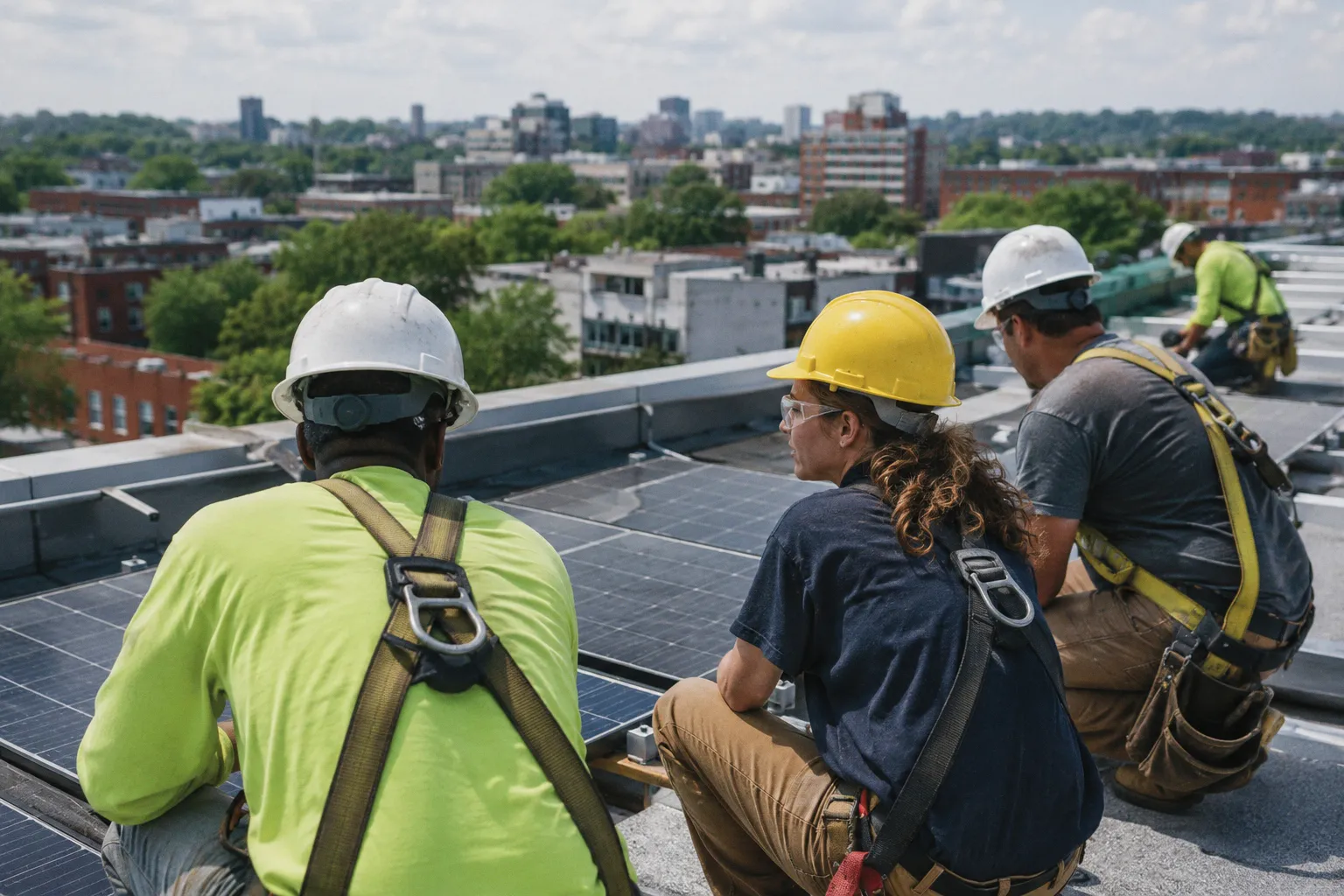
Evaluating Green Workforce Training: A Guide to Union-Backed Apprenticeships
The Inflation Reduction Act routed roughly $369 billion into the clean energy transition, and tucked inside the tax credit architecture was a quiet but consequential lever: developers who pay prevailing wages and hire from registered apprenticeship programs now collect the full credit; those who don't see their subsidy slashed by as much as 80%. That single structural decision rewires the economics of every solar array, grid retrofit, and heat pump installation built with federal incentive money. When you compare green job training programs in your state, that distinction is not academic. It is the difference between a wage that lets a single parent in Cleveland stay in their neighborhood and a certificate that funnels someone into a contractor's bidding pool at $19 an hour with no health coverage and no grievance procedure.
The flood of state and federal capital has produced a parallel explosion of training providers. Some trace back decades as union apprenticeship programs with collective bargaining agreements already in place. Others are short-term bootcamps launched in 2023 by for-profit workforce intermediaries chasing Greenhouse Gas Reduction Fund dollars. The two are not equivalent. One builds collective leverage. The other builds a resume line. We need to be blunt about which is which, because the difference compounds across an entire working life.
The Gold Standard: Why Registered Apprenticeship Programs Outperform Short-Term Certificates
A Registered Apprenticeship Program (RAP) is a specific federal designation, not a marketing term. RAPs combine paid on-the-job learning with classroom instruction, run for one to six years depending on the trade, and culminate in an industry-recognized credential that is portable across state lines. The U.S. Department of Labor maintains a public registry through Apprenticeship.gov, and any program listed there has cleared minimum standards for curriculum, supervision ratios, and wage progression.
That matters because the alternative — the six-week "solar installer certificate" — typically delivers none of those protections. Short-term programs are often subsidized by the same GGRF dollars that should be flowing into RAPs, and they graduate cohorts into a labor market where the contractor holds nearly all the leverage. Workers walk away with a credential, but they lack portable wages, structured advancement, and the legal scaffolding that comes with apprenticeship registration.
Consider the structural difference in concrete terms. A first-year electrical apprentice inside a registered program earns roughly 50% of the journeyworker rate and receives a guaranteed raise every six to twelve months, spelled out in the collective bargaining agreement, until they reach full scale. That wage progression is not subject to the contractor's discretion. It is a contractual obligation enforceable through the grievance procedure. A graduate of a non-registered certificate program, by contrast, enters the labor market at whatever wage the employer decides to offer that week. There is no escalation schedule. There is no grievance mechanism. There is no portability guarantee. The certificate says you completed training. It says nothing about what happens next.
The Department of Labor's own data underscores the point. Workers who complete RAPs earn a median of $77,000 annually after completion, compared to roughly $30,000–$35,000 for graduates of short-term workforce certificates in the same sectors. The lifetime earnings differential is not marginal. It is generational. And yet the policy infrastructure under GGRF continues to fund both pathways at comparable per-participant costs, which raises a question about whose interests the funding architecture actually serves.
A six-week certificate and a Registered Apprenticeship are not on the same continuum. One is a stepping stone. The other is career infrastructure.
The structural critique here is straightforward: when a workforce intermediary promises "pathways into clean energy" without disclosing whether those pathways terminate in union membership, in a prevailing-wage job, or in a non-union shop paying $16 an hour with no benefits, they are obscuring material conditions behind aspirational language. That obscurity is not incidental. It is the product.
Decoding the Inflation Reduction Act: How Federal Funding Mandates Prevailing Wages
The IRA's clean energy tax credits — sections 45, 48, and 45X for those tracking the statutory citations — embed labor conditionality directly into the incentive structure. To claim the full credit value on most large projects, developers must pay prevailing wages as defined by the Davis-Bacon Act and employ apprentices from registered programs for a specified minimum number of hours per project. Projects that fail to meet those thresholds see their tax credit value collapse, often by five times the baseline amount.
That penalty architecture is the entire point. It converts prevailing wage from a compliance checkbox into a financial incentive. Developers who want to maximize returns now have a direct fiscal reason to seek out union contractors and apprenticeship sponsors, because those entities already operate at the wage and training thresholds the IRA rewards. The market signal flows downhill from the credit structure to the contractor to the training program that feeds the contractor.
There is a wrinkle worth noting. The IRA's apprenticeship requirements apply on a project-by-project basis, which means a developer can claim full credits on one project while running non-union on another project that falls below the threshold or qualifies under a different credit section. The labor conditionality is strong where it applies, but it does not blanket the entire industry. Workers evaluating training programs need to understand this selectivity: the law protects you if you are dispatched to an IRA-qualifying project. It does not protect you if you are working for the same contractor on a private development that does not draw federal incentives.
The practical consequence for a worker evaluating any green training program: ask whether the program's primary employer partners have committed to IRA-qualifying projects. If they have, the wage floor is set by federal labor law, not by what the contractor feels like paying. If they have not, you are gambling on the unregulated end of a market where contractors routinely underbid union shops by suppressing labor costs and skipping apprenticeship ratios. The IRA created two labor markets inside one industry. Knowing which one you are entering is the most consequential decision you will make about your training.
Vetting State Initiatives: Identifying Community Benefit Agreements and Labor Protections
The Greenhouse Gas Reduction Fund, administered by the EPA and disbursed through state green banks, nonprofit grantees, and tribal governments, requires many recipients to negotiate Community Benefit Agreements as a condition of award. CBAs are contracts between developers and local stakeholders — often including unions, community organizations, and workforce boards — that lock in commitments around local hiring, wage floors, apprenticeship utilization, and minority-owned business participation.
This is where state implementation diverges sharply, and where the complicity of weak enforcers becomes visible. Some states have written CBA requirements with teeth: project labor agreements, hiring hall access, enforceable grievance procedures, and state-level oversight. Other states have produced CBAs that amount to press releases, written in vague language with no enforcement mechanism and no penalty for noncompliance. The structure of the CBA, not its existence, tells you whether a state is using GGRF money to build a workforce or to launder its optics.
| Diagnostic Check | What a Real Program Shows | What a Greenwashed Program Shows |
|---|---|---|
| CBA Enforcement | Grievance procedure, binding arbitration, state audit authority | "Voluntary commitments" with no penalty clause |
| Apprenticeship Hours | Minimum registered apprentice hours written into contract | No apprentice utilization target specified |
| Wage Floor | Davis-Bacon or higher, named by classification in writing | Reference to "competitive wages" without a number |
| Hiring Pipeline | Formal partnership with union hall or RAP sponsor | Open referral system with no structured pathway |
The table above is not a checklist for the sake of completeness. It is a diagnostic tool. A program that cannot answer these four questions with specifics is not yet a program. It is a proposal, and proposals have a way of staying proposals when enforcement authority is absent.
State-level enforcement bodies matter enormously here. The National Association of State and Territorial Apprenticeship Directors tracks which states operate their own federally recognized apprenticeship agencies (27 states and territories as of recent counts) versus relying on the federal Office of Apprenticeship. States with their own agencies tend to have tighter registration standards, more aggressive audit cycles, and better data on program performance. If your state defers to the federal office, the oversight gap is real — not because federal staff are negligent, but because the ratio of registered programs to field investigators is unsustainable in most regions.
Navigating CareerOneStop and State Portals to Filter for Quality Training
The Department of Labor's CareerOneStop portal allows workers to filter training programs by state, industry sector — renewable energy, energy efficiency, grid modernization, weatherization — and credential type. It is a starting point, not a destination. The portal lists both RAPs and non-registered certificate programs side by side, with no visual hierarchy that signals the difference to a user who does not already know what to look for.
What the portal cannot tell you: whether the program is union-sponsored, whether its employer partners pay prevailing wages, or whether graduates actually place into jobs at the wages advertised in the program description. For that information, you need to cross-reference the program's RAP status on Apprenticeship.gov, search for the sponsoring union local's collective bargaining agreement online, and contact the state apprenticeship council directly to confirm that the program's registration is current and not lapsed.
A practical sequence for a worker starting from zero:
1. Start on CareerOneStop.org. Filter by your state and select the relevant sector — solar, wind, energy efficiency, or electrical. Generate the full list of training providers.
2. Cross-check every result against Apprenticeship.gov. If a program does not appear in the federal RAP registry, it is not a registered apprenticeship regardless of what its website claims. This is non-negotiable.
3. Identify the sponsoring entity. For union RAPs, the sponsor is typically a joint apprenticeship and training committee (JATC) co-managed by the union and employer association. For non-union RAPs, the sponsor may be a single employer, a group of employers, or a community college. The sponsor structure determines who sets the curriculum, who enforces standards, and who processes grievances.
4. Call the state apprenticeship council. Ask specifically whether the program's registration is active, when it was last audited, and what its completion rate looks like over the past three years. If the council cannot or will not answer, that is a data point in itself.
5. Look for the project pipeline. A training program is only as good as the projects its graduates will work on. Ask what specific IRA-qualifying or GGRF-funded projects the program's employer partners have in the pipeline. If the answer is vague, the job placement claims are likely also vague.
State portals vary widely in transparency. California, New York, Washington, and Massachusetts publish detailed program performance data, including completion rates, median wages six months after exit, and the share of graduates placed into registered apprenticeship continuation. Other states publish a directory and little else. If you live in a state with thin data, the absence of information is itself the answer: the program has not been made accountable to public scrutiny, and the political will to enforce federal labor standards on GGRF recipients is not currently present.
The Reality Gap: Between Industry-Recognized Credentials and Union-Protected Careers
The phrase "industry-recognized credential" appears in nearly every green jobs grant application filed since 2022. It sounds technical and reassuring. It is also one of the most deliberately underdetermined terms in the workforce development field. An industry-recognized credential can be issued by a manufacturer (NABCEP for solar, BPI for building performance), by a community college, by a private training vendor, or by a union apprenticeship program. The credential itself does not encode the wage conditions under which it will be used.
This is where the structural critique sharpens. A credential is portable. A union contract is also portable, but it carries wages, benefits, and grievance rights along with it. The market treats these as interchangeable because both appear on a resume. They are not interchangeable. A NABCEP certificate held by a worker in a non-union state does not unlock the same compensation as the same certificate held by a worker dispatched through IBEW Local 11 in Los Angeles or IBEW Local 103 in Boston. The credential is identical. The labor market is not.
Industry-recognized credentials tell an employer you have skills. Union-protected careers tell an employer you have leverage.
The field of credential inflation deserves scrutiny here. As federal and state dollars pour into clean energy workforce development, the number of credential-issuing entities has multiplied. Some credentials carry genuine weight in hiring decisions — NABCEP's PV Installation Professional certification, for instance, is referenced in many contractor bidding requirements and some state licensing statutes. Others are issued by organizations that exist primarily to capture training subsidies, and their graduates enter the labor market with a document that impresses no one who signs paychecks. The proliferation of low-value credentials is not a side effect of the clean energy transition. It is a business model.
We should be precise about what we are asking training programs to deliver. If the answer is "skills," any program will do. If the answer is a wage that pays rent, health coverage that survives a layoff, and a retirement plan that is not a crypto allocation, then the answer is specifically a registered apprenticeship with a union sponsor, or a non-union program whose employer partners have signed enforceable project labor agreements. Everything else is adjacent.
The Material Conditions of a Real Green Jobs Pipeline
A functional green jobs pipeline does not begin with a training program. It begins with a project labor agreement, a community benefit agreement, or a prevailing wage determination that sets the floor. Training programs attach to that floor and feed into it. The IRA and GGRF are structured to incentivize exactly this attachment, but only if state implementers and local workforce boards choose to enforce the conditionalities already written into the funding.
When they do not, the money flows anyway. Developers claim credits, training providers graduate cohorts, and workers collect certificates that do not cash into the wages the rhetoric promised. This is not a failure of the clean energy transition. It is the transition functioning as designed for capital and malfunctioning for labor. That malfunction is not accidental. It is the predictable outcome of weak enforcement and the political cowardice of state agencies that prefer ribbon-cuttings to grievance procedures.
Workers, and the unions that represent them, should treat every green jobs announcement with the same skepticism they would apply to any corporate press release: follow the money, identify the contractors, check whether the project is subject to Davis-Bacon, and confirm the apprenticeship utilization rate in writing. If the answers are not on the record, the program is not ready. If they are on the record, verify them against the filings on file with the state apprenticeship council, not against the marketing materials the workforce intermediary handed you at a job fair.
The choice is not between clean energy and union jobs. The IRA already settled that. The choice is whether we enforce the architecture the law built, or allow the next decade of green infrastructure to be built by the same contractors who built the extractive economy — only with a different logo on the hard hat.
That choice is made at the state level, on workforce board rosters, in the language of community benefit agreements, and in the enforcement actions — or inaction — of state apprenticeship councils. It is not made through hope. It is made by workers showing up to public comment periods, by unions filing FOIA requests on GGRF disbursements, and by journalists asking contractors to put their prevailing wage attestations on the record in writing. The infrastructure for a unionized green economy is partially built. The rest is enforcement work, and enforcement is something we either do, or we pay for the rest of the decade in extracted wages dressed in green packaging.