The data center backlash that's uniting America
The New York State Assembly just did something rare — it forced a pause on the most ravenous infrastructure boom of our generation. Lawmakers passed the country's first statewide moratorium on large new data centers this month, sending the bill to Gov.
Harrison Lockwood, Lead Columnist on Systemic Justice & Climate Action·updated June 26, 2026
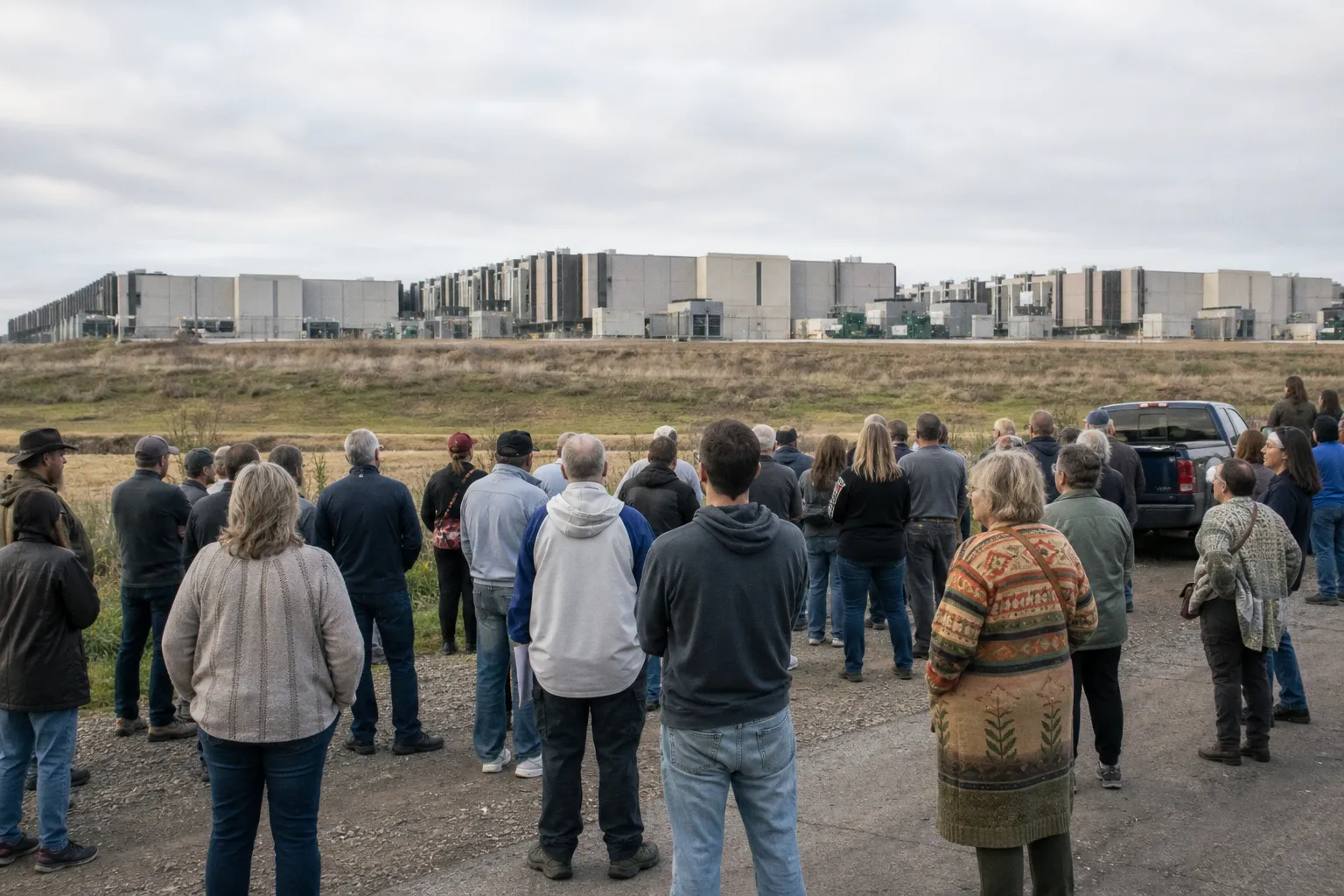
The $150 billion stop sign
Community opposition stalled or killed more than $150 billion worth of data center projects last year, according to research from Data Center Watch, cited by Nation of Change. That is not a protest statistic. That is capital rerouted by organized people refusing to absorb the costs of someone else's compute.
Seth Gladstone of Food and Water Watch puts the math plainly: the boom arrived so fast that the only proportionate response is to press pause. In Seattle — now the largest U.S. city with its own moratorium — four Big Tech firms surfaced permit applications this April for at least five large facilities. One proposal, a Digital Realty project, would require a six-story building downtown. Taken together, Ben Jones of 350 Seattle told organizers, those projects would consume energy equivalent to roughly a third of Seattle's total footprint.
This is extraction in its cleanest form. Hyperscalers externalize water draw, grid strain, and electricity price spikes onto municipalities that never consented to host the load. The communities absorbing the burden — including Central Washington counties already staring down major proposals — are not the ones cashing the returns.
The non-partisan math
What makes this fight unusual is the coalition geometry. Michél Legendre of the Dogwood Alliance, which mobilizes against data center buildouts tied to Southern forest loss, told reporters that even seasoned environmental groups have been "caught kind of flat-footed" by the volume and speed of proposals. Seattle's moratorium coalition — 350 Seattle, Seattle Troublemakers, and Seattle DSA — is progressive, but the pressure is not. Gladstone frames it bluntly: "This isn't a partisan issue. No one wants to pay exponentially more for electricity, and no one wants to deal with water scarcity."
That cross-aisle framing matters. Data centers are not an abstraction. They are a utility bill, a dry aquifer, a substation nobody budgeted for. When the material conditions bite, ideology thins out fast.
What to watch
Hochul's signature is the immediate lever. If she signs, New York becomes the first state to legislate a hard pause; if she vetoes, the bill converts into a national organizing vehicle rather than a loss. Locally, track whether Seattle's moratorium holds against permits already in the pipeline, and whether Central Washington counties follow with their own moratoriums. Nationally, watch the utility commissions in red states where the bipartisan pressure is real — because that is where corporate lobbying concentrates, and where this fight either hardens into law or gets quietly buried.
The rest of us have a narrower job: show up to the public utility commission hearings, back the local moratorium campaigns, and stop treating compute as if it were weightless. It is not. It runs on water, copper, gas turbines, and our consent.