Train protest marshals to de-escalate police interactions
In 2023, municipal governments across the United States allocated a combined $137 billion to policing, while funding for social safety nets, public housing, and climate resilience faced relentless austerity.
Harrison Lockwood, Lead Columnist on Systemic Justice & Climate Action·Updated: June 29, 2026·11 min read
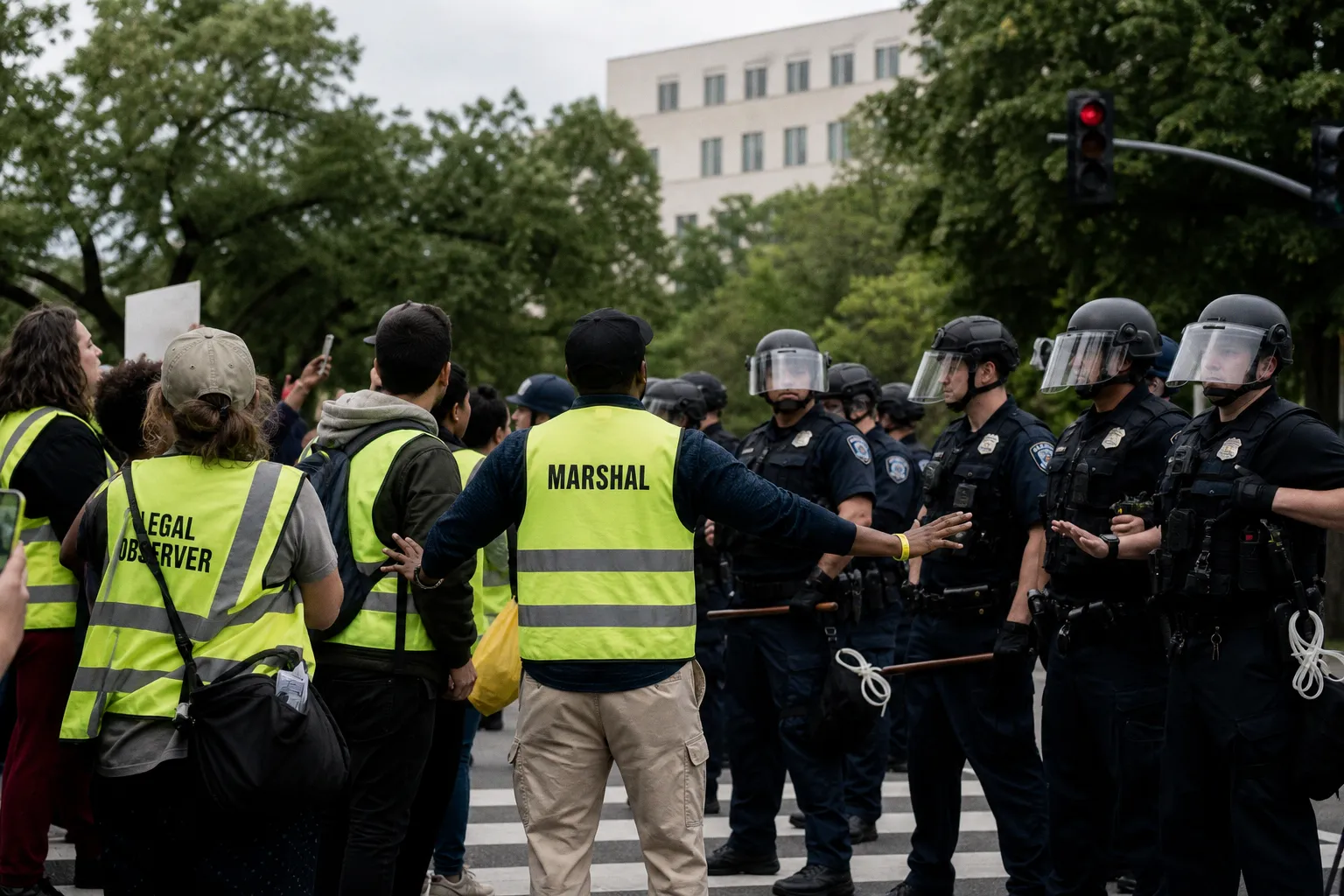
We must abandon the naive belief that the state will respect assembly rights out of moral obligation. History shows they will use any pretext—a stepped foot, a raised voice, a physical bottleneck—to justify dispersal and mass arrests. Therefore, building a disciplined, structured internal security apparatus is the only way to retain leverage on the ground. When we discuss how to check train protest marshals to de-escalate police interactions progressive politics demands that we look beyond simple crowd control and analyze the material conditions of state power.
The Role of the Marshal: Defining the Buffer Zone
What is a protest marshal? Let's strip away the corporate buzzwords of "empowerment" and "dialogue." A marshal is a physical and psychological buffer. They exist to manage the internal dynamics of the crowd and to absorb, delay, or redirect the initial friction of police contact. They do not possess legal authority to stop police from making arrests, nor do they enjoy any special immunity under international or domestic law. To claim otherwise is a dangerous delusion that sets up volunteers for systemic violence.
Instead, their utility is entirely practical. They manage the flow of the march, keep lines intact, and act as a human barrier between the state’s tactical units and the vulnerable core of the demonstration. Crucially, we must distinguish between marshals and legal observers.
| Parameter | Protest Marshals | Legal Observers |
|---|---|---|
| Primary Function | Active crowd management, de-escalation, and physical buffering. | Objective documentation of police behavior and civil rights violations. |
| Interaction with Police | Direct, neutral communication to lower tension and delay escalation. | Minimal to zero interaction; passive observation and recording. |
| Legal Standing | No formal legal status; subject to the same arrest risks as general protesters. | Typically trained by legal guilds (e.g., NLG); wear distinct identifiers to document evidence for court. |
| Positioning | Perimeter of the crowd, intersections, and direct points of police contact. | Flanks of the crowd, positioned to clearly film and record police actions without interfering. |
By defining these roles clearly, we prevent the tactical confusion that police exploit. When marshals try to act as legal observers, they stop watching the crowd and start watching their cameras, leaving the perimeter exposed. Conversely, when legal observers attempt to intervene physically, they lose their objective status and risk arrest, depriving the movement of crucial documentation.
The 3-Step Communication Framework: Observe, Assess, Act
De-escalation is not about pacifying the crowd's righteous anger; it is about denying the police the tactical excuse they need to deploy force. The state wants chaos because chaos justifies violence. Marshals enforce discipline through a structured, three-step communication model: Observe, Assess, and Act.
1. Observe
Marshals must scan the perimeter constantly. They look for changes in police posture—such as the donning of helmets, the movement of bicycle lines, or the arrival of arrest vans. They also watch for internal stressors within the crowd, such as bottlenecks, panic, or agitators attempting to provoke a premature confrontation. Observation is not passive; it is an active, continuous intelligence-gathering operation. A marshal’s eyes are their primary tool. They note the shifting weight of an officer’s stance, the direction of a supervisor’s radio call, the nervous energy propagating through the crowd’s periphery. This granular awareness allows them to spot the difference between a routine show of force and the preparatory movements for a kettle.
2. Assess
Once an anomaly is spotted, marshals quickly evaluate the threat level using a simple triage. Is the police movement a standard rotation, or are they preparing a kettle? Is a confrontation localized, or does it threaten the entire line? Is a fellow protester’s emotional escalation likely to trigger a mass arrest? This assessment dictates the level of response. A localized argument might require a single marshal with calm language. The deployment of zip-tie cuffs to an officer’s belt, however, signals an imminent arrest team, requiring a coordinated buffer response from the entire flank. This mental calculus must happen in seconds.
3. Act
Action must be swift, coordinated, and non-confrontational. The primary tactical objective is to control the geometry of the confrontation. If a police line is advancing, marshals do not push back—which provides the legal pretext for an assault charge—but instead form a line of locked arms to slow the advance and allow the crowd behind them to retreat safely. Verbal commands are short, clear, and factual. "Step back." "Link arms." "Maintain the line." Emotion is a vulnerability the state will exploit. A marshal’s calm, dispassionate voice in the face of aggression is a tactical asset, psychologically disrupting the expected script of provocation.
De-escalation is not a tool to suppress dissent; it is a tactical choice to preserve our collective leverage and keep our people out of the state's jail cells.
In executing this framework, marshals must employ active listening and non-confrontational body language. This means keeping hands visible, palms open, and maintaining a calm, even vocal tone. When interacting with police, marshals must adopt a strictly neutral stance. The goal is simple: avoid providing any verbal or physical hook that a hostile officer can use to justify an arrest or a dispersal order. The marshal’s body is a wall, not a weapon. Their words are tools of navigation, not debate.
Maintaining Physical and Legal Boundaries During Confrontations
In the heat of an action, distance is safety. The National Lawyers Guild and other civil rights advocates emphasize maintaining a physical buffer between the protest line and police barricades. A recommended distance of 10 to 15 feet from police lines should be maintained whenever possible. This gap prevents accidental physical contact, which officers frequently mischaracterize as assault to initiate arrests. It also provides a critical reaction zone. If a snatch squad breaches the line, that 10-foot gap gives marshals and the crowd precious seconds to reposition, link, and solidify a new buffer.
Direct action demands a highly specialized, tactical protocol. A marshal's physical positioning is a matter of material safety, not casual navigation. It is a calculated deployment of human bodies to manage risk.
When police begin to close this gap, marshals must step into the space to act as the buffer. They do not engage in verbal sparring, debate policy, or shout slogans at the officers. Such actions only increase the collective adrenaline and accelerate the timeline to violence. Instead, they state clear, factual observations: "We are moving the crowd back," or "We are maintaining this line." By keeping communication transactional, marshals force the police to interact with a disciplined wall rather than an emotional crowd. This is the core of de-escalation: removing the emotional fuel from the confrontation.
The Transactional Dialogue: Sample Phrases for Marshal-Police Interaction
- To announce a crowd movement: "We are creating space for the crowd to move back safely."
- To acknowledge a police command without accepting guilt: "I hear your dispersal order. We are moving the crowd now."
- To request clarification without challenge: "Can you specify which direction you want the crowd to move?"
- To create a factual record during an arrest: "I am a legal observer. This individual is not resisting. We have witnesses."
This language is sterile by design. It denies the officer the satisfaction of a debate and refuses to provide the "disorderly conduct" or "failure to obey" pretext that can turn a single arrest into a cascade of violence. The marshals’ discipline becomes the crowd’s discipline.
Managing High-Risk Scenarios: Ratios and Crowd Dynamics
An unorganized crowd is highly vulnerable to police maneuvers like kettling or targeted snatch squads. To prevent this, organizers must implement strict organizational ratios. For high-risk civil disobedience actions, a 1:20 marshal-to-protester ratio is the baseline requirement. Without this level of density, marshals cannot effectively communicate, manage crowd flow, or react to rapid police movements. In a sea of 200 people, a team of 10 marshals can control key vectors. A team of 5 will be overwhelmed.
Tactical Deployment of Marshals
1. The Vanguard: Positioned at the very front of the march to set the pace and negotiate intersections before the crowd arrives. They ensure the march does not move too quickly, which can stretch the line and make it vulnerable to being cut in half. The vanguard’s job is pathfinding and tempo control.
2. The Flanks: Positioned along the sides of the march to prevent police vehicles or bicycle units from cutting into the crowd. They maintain the shape of the march and keep protesters on the designated route. They are the first to absorb pressure from side streets and intercept attempts to split the crowd.
3. The Rearguard: Positioned at the back to protect the crowd from being rear-ended by police lines or targeted for snatch-and-grab arrests. They act as the final buffer during a retreat and are critical for providing real-time information on the pace and proximity of pursuing forces.
This distribution allows the marshal team to function as a cohesive unit with overlapping fields of control. Communication between these teams, via pre-arranged hand signals or discreet radios, is non-negotiable. In decentralized actions, there is no single standardized certification program for protest marshals; training is decentralized and organization-specific. This lack of standardization means that the burden of preparation falls entirely on the local organizing coalition. If we do not train our own people, we leave them defenseless. The materials are available—guides from the NLG, histories of movements—but the will to drill, to run scenarios, to hardwire responses into muscle memory, is what separates a disciplined march from a vulnerable one.
Coordinating with Legal Observers and Medical Support
A successful action requires a division of labor. Marshals cannot be legal observers, and they cannot be street medics. Attempting to combine these roles leads to cognitive overload and tactical failure. A marshal’s hands need to be free to link with others; a legal observer’s hands need to be fixed on a camera. These are incompatible physical realities.
While marshals manage the crowd's physical safety and attempt to de-escalate interactions, legal observers must remain independent. They do not intervene, they do not negotiate, and they do not speak to the police. Their sole job is to document the state's violence. This documentation provides the evidentiary basis for the legal defense of those arrested and, when shared publicly, shapes the narrative of the confrontation. Their neutrality is their power.
The presence of a camera is a form of leverage, but only if the person holding it is focused entirely on the lens, not the physical struggle.
Similarly, street medics must be kept behind the marshal lines, protected from direct police contact so they can treat injuries without becoming casualties themselves. A medic arrested is a medic lost. Marshals must understand that their role is to protect the space in which medics and observers operate, reinforcing the structural resilience of the entire mobilization. This is not about individual heroism; it is about the tactical preservation of key functions within the movement’s ecosystem. The medic saves bodies. The observer saves legal futures. The marshal saves the space for both to do their work.
The Material Reality of Street Action
We do not train marshals because we believe the police are reasonable actors who can be reasoned with. We train them because we know the police are the enforcement arm of a system designed to protect property over human life. When we organize, we must do so with a clear-eyed understanding of these material conditions. The $137 billion question is not about public safety; it is about whose safety is prioritized and through what means.
De-escalation training does not guarantee safety, nor does it prevent police violence in all scenarios. What it does is shift the tactical balance. It gives the crowd structure, discipline, and a collective shield. It transforms a reactive mass into a proactive formation. By implementing the 3-step communication model, maintaining physical distance, and deploying disciplined teams at a 1:20 ratio, we strip the state of its easiest justifications for violence. We force a choice upon the enforcers: to use overt, brutal force against a disciplined, non-violent formation is a politically costly spectacle that strains the state’s legitimacy narrative.
We protect our people, preserve our movement's resources, and keep the focus where it belongs: on dismantling the systemic inequalities that brought us to the streets in the first place. The training is not an end; it is the means to sustain the fight long enough to win it.