Progressive politics: why local action matters most
Over 1,500 cities now practice some form of participatory budgeting. That figure is not a slogan or a feel-good metric buried in a nonprofit annual report.
Harrison Lockwood, Lead Columnist on Systemic Justice & Climate Action·Updated: July 12, 2026·12 min read
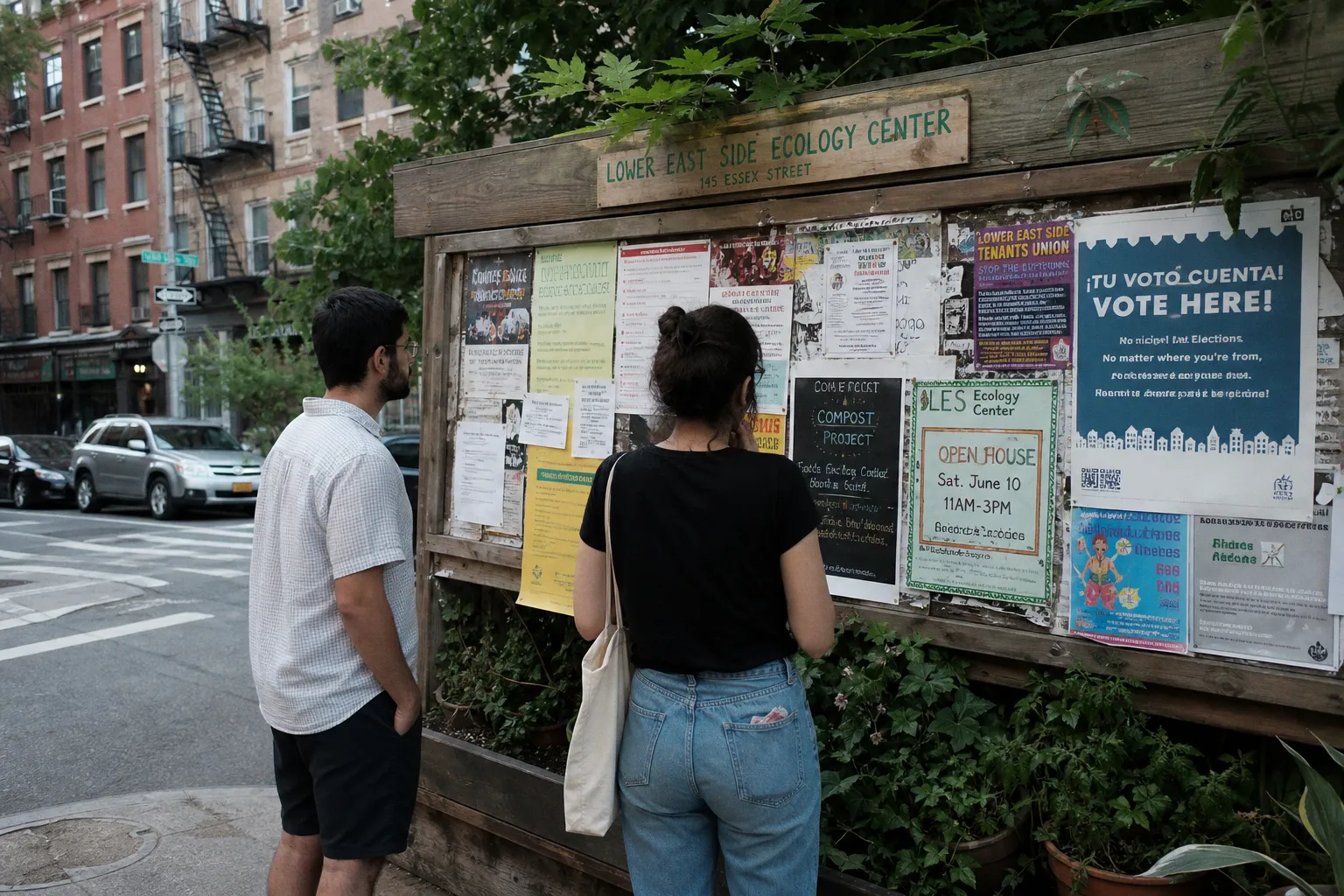
That is what progressive politics looks like when it stops waiting for permission from Washington. It does not begin with a manifesto. It begins with a line item.
For decades, the left has organized itself around the assumption that meaningful change descends from the federal level. Win the White House, win the Senate, ram through a bill, watch the country transform. That theory has produced a string of narrow legislative windows, a handful of half-measures, and an enormous amount of disillusionment. Meanwhile, the structural conditions that determine whether ordinary people can afford rent, send a child to a decent school, or survive a hospital visit have been settled, repeatedly, in rooms most voters never see: city councils, school boards, county commissions, municipal courts. The federal floor is where rights are declared. The local machinery is where rights are administered, defunded, or quietly erased.
This is not a sentimental case for "starting small." It is a structural argument about where power actually accumulates, and where it can be pried loose. We have spent a generation treating local government as a junior-varsity training ground for higher office. The evidence now suggests it is the only office that matters in the immediate term, and the only one within reach of a coherent progressive political movement that has grown tired of losing the same federal argument every four years.
The Municipal Laboratory: Scaling Grassroots Innovation
The federal government is, at this moment, structurally incapable of passing transformative legislation. That sentence is not hyperbole; it is the working definition of a Senate filibuster that requires sixty votes to end debate on most substantive matters, a House majority that swings with each electoral cycle, and a judiciary increasingly willing to nullify whatever does emerge. The Biden administration passed the Inflation Reduction Act, the CHIPS Act, and a modest gun safety bill before losing the chamber. The Trump administration before it passed a tax cut for the wealthiest households and tried, repeatedly, to repeal the Affordable Care Act. The ceiling is low, the floor keeps dropping, and the median progressive policy idea dies somewhere between committee markup and a cloture vote.
Local government operates under none of these constraints. Mayors cannot be filibustered. City councils do not require sixty votes to pass a resolution. A single ordinance, signed in a single evening, can change the material conditions of tens of thousands of households within a single fiscal year. That is not a quirk of municipal law. It is a feature — one the left has been ignoring for forty years.
The objection, when one is raised, is scale. A city cannot pass Medicare for All. A county cannot abolish ICE. These are true statements, and they are also a deflection. The same critique, applied with equal seriousness, would have ruled out every successful federal reform of the last century, because the New Deal began as a series of state-level experiments, and the civil rights legislation of the 1960s was preceded by decades of local organizing that built the political infrastructure necessary for national action. Local action is not a consolation prize for those who lost the presidential primary. It is the rehearsal space without which the national progressive movement has no script at all.
A compact inventory of what is actually working at the municipal level makes the argument concrete:
| Reform Tool | Where It Has Taken Hold | What It Changes |
|---|---|---|
| Participatory budgeting | 1,500+ cities globally; NYC since 2011 | Discretionary capital spending allocated by residents, not council members |
| Democracy Vouchers | Seattle (since 2017) | Candidate funding sourced from $25 vouchers, not corporate checks |
| Ranked-choice voting | 50+ U.S. jurisdictions as of 2023 | Single-vote plurality replaced with ranked ballots; reduces spoiler effect |
| Non-citizen local voting | Jurisdictions in VT, MD, CA | Local franchise extended to taxpaying residents excluded from federal elections |
| School board mobilization | District-level, all 50 states | Direct control over curriculum, hiring, and 90% of K-12 funding decisions |
These are not parallel movements. They are the same movement, fought on five different fronts, and the donor class knows it.
Democratizing the Budget: Lessons from 1,500 Global Cities
Participatory budgeting is the clearest working example of what this looks like in practice. The model, exported from Porto Alegre in the late 1980s, now operates in over 1,500 municipalities worldwide. New York City launched its program in 2011 through four district council members, and it has since expanded to dozens of council districts across the boroughs. Residents gather, propose projects, debate them in public, and vote on how a portion of discretionary capital funds gets spent. The amounts are not symbolic. In many districts, the pool runs into the millions.
The mechanism matters more than the money. Participatory budgeting forces two things into the open that corporate-funded municipal politics usually buries. First, it makes trade-offs legible. A community that wants new speed bumps, after-school programs, and a renovated playground cannot fund all three at once, and the discussion about which to prioritize is no longer conducted behind closed doors by council members chasing developer donations. Second, it builds a constituency for the program itself. People who have voted on a budget line item do not easily return to a system where someone else decides for them.
Participatory budgeting is not a participatory exercise. It is a redistribution of who holds the pen.
The right has responded with two predictable moves. They have argued, with no supporting data, that participatory budgeting produces "wasteful" spending, and they have moved to preempt it at the state level wherever Republican legislatures hold the gavel. Both responses are revealing. The complaint about waste is the same complaint that was raised against public schools, Social Security, and the postal service in their early years: a defense of incumbent extraction dressed up as fiscal responsibility. The preemptive strikes are the clearest confirmation that local democratic reform threatens the donor class that funds state-level Republican politics. When the response is to ban the reform rather than contest it on its merits, you know you are looking at a structural threat to power, not a policy disagreement.
Breaking the Corporate Grip: Campaign Finance and Voter Access
Campaign finance is the other front where the municipal level has produced the most legible results. Seattle's Democracy Vouchers program, launched in 2017, gives every registered voter four $25 vouchers they can assign to participating candidates. Candidates who accept vouchers agree to limit traditional fundraising and refuse corporate contributions. The early data is unambiguous: the program increased the number of small-dollar donors, diversified the candidate pool, and demonstrably reduced the leverage of large contributors in citywide elections.
That last effect is the one corporate media tends to ignore, because it is the one that actually threatens the donor architecture of both major parties. A municipal election funded by $100 vouchers cannot be bought by a single check from a developer or a hedge fund manager. Candidates who would never have run under the old system, because they could not access the rooms where big checks get written, are now viable. The composition of the candidate pool shifts. So does the composition of the policy outcomes, because candidates who are not answering to a single donor base tend to answer to the people who put them in office.
Voter access reform follows the same logic. Several U.S. municipalities have extended local voting rights to non-citizen residents, including jurisdictions in Vermont, Maryland, and California. These policies are not symbolic. They determine who controls school boards, zoning boards, and municipal courts in cities where non-citizens make up substantial portions of the population and pay local taxes without representation. Legal challenges are ongoing. State legislatures have moved to preempt. The point is not that every such effort survives the courts. The point is that the fight itself clarifies who benefits from restricted electorates, and who pays the price for them. That clarity is itself a form of progressive grassroots organizing, because once you can name the constituency for voter suppression, you can mobilize against it.
The Frontline of Education: Why School Boards Define Policy
State and local governments fund approximately 90 percent of K-12 education in the United States. That single number explains why the school board meeting, not the White House press briefing, is the most consequential room in American public life for anyone serious about educational equity. The federal role is, by design, residual. Title I funding, IDEA special education mandates, and the occasional competitive grant program are meaningful, but they sit on top of a foundation set almost entirely by state legislatures and, increasingly, by local school boards.
The right understood this a decade before the left did. The wave of school board recalls and curriculum battles that began in 2021 was not spontaneous; it was coordinated, well-funded, and aimed at the precise point where educational policy gets made. The left's response, where it has shown up at all, has been inconsistent. We have nationalized every other fight — the Supreme Court, the filibuster, the presidency. We have not yet nationalized this one in any serious way, and the result is that school boards in swing districts are being captured by organized minorities running on grievance, while the actual majority of parents who want functional schools and accurate curricula fail to show up at the polls.
This is the moment where the standard left response is some version of "we need to do better at mobilizing." That is the corporate progressive phrase, and it is wrong. We do not need to mobilize better. We need to recognize that school board elections are policy elections, full stop, and we need to treat them with the seriousness they deserve — the same seriousness the right has been treating them with since at least the Citizens United decision.
The same logic applies to county commissions that administer public health, library boards that determine what books children can access, and municipal courts that issue eviction orders. Every one of these is a left-wing political strategy that has been hiding in plain sight, and every one is currently understaffed by the very constituencies that have the most to lose from a hostile takeover.
Beyond the Ballot: Structural Reforms and Electoral Integrity
Ranked-choice voting has now been adopted by over fifty U.S. jurisdictions for local elections, and the pattern of adoption is worth tracing. Cities that adopted RCV did so through ballot measures, often against the opposition of both major parties and the local business establishment, on the argument that single-choice plurality voting systematically produces spoiler effects, negative campaigning, and winners who command a small fraction of the actual electorate. The early data is still being collected, but the results are consistent: RCV reduces negative campaigning, increases the share of voters who participate in later rounds, and produces winners with broader coalitions.
The opposition is the usual cast. State legislatures, mostly Republican-controlled, have moved to preempt local RCV adoption. The argument is about "voter confusion," which is the same argument that was used against women voting, against absentee ballots, and against the direct election of senators. It is never actually about confusion. It is about the composition of the resulting electorate, and the threat that a more representative one poses to incumbent power. When the policy establishment mobilizes against a procedural reform that the evidence consistently shows produces fairer outcomes, you are not looking at a disagreement about process. You are looking at a fight over who counts.
The donor class is not confused by ranked-choice voting. They are threatened by it.
This is where the broader structural argument becomes clear. Local electoral reform, local budget reform, and local campaign finance reform are not three separate fights. They are the same fight, waged at the level where it can be won, against a donor class that funds the state-level preemption campaigns which then try to undo the local victories. The left has spent years pretending that the only meaningful politics happens in Washington. The donor class knows better, which is precisely why they are spending millions to prevent these reforms from taking hold at the level where they actually work.
The Future of Progressive Policy Is Being Written in City Hall
What we have, then, is a choice. We can continue to wait for a federal majority that the structure of the Senate makes nearly impossible, organize around a presidential cycle that delivers a slim legislative window every eight to twelve years, and watch as the courts dismantle whatever emerges. Or we can treat the next two years as what they actually are: the most important electoral period in a generation, conducted almost entirely at the local level, against state-level preemption campaigns funded by the same handful of conservative donors who have already lost the argument on policy but continue to win the argument on geography.
The municipal laboratory is not a metaphor. It is a structural fact, and it is the only structural fact currently working in our favor. Participatory budgeting, Democracy Vouchers, ranked-choice voting, non-citizen local suffrage, and school board organizing are not progressive aspirations. They are progressive infrastructure, already built, already functioning, and already under coordinated attack by the same interests that fund the rest of the right-wing project. Defending them is not a substitute for national politics. It is the precondition for any future of progressive policy that survives contact with the courts.
The next time someone tells you that local elections don't matter, ask them who they think is funding the state-level campaigns to overturn the results.