What is mutual aid and why is it surging?
Within weeks of the March 2020 lockdowns, federal unemployment systems across the United States crashed under historic claim volumes. State hotlines jammed.
Harrison Lockwood, Lead Columnist on Systemic Justice & Climate Action·Updated: July 14, 2026·11 min read
The Pandemic Didn't Break the Safety Net. It Confirmed It Was Already Gone.
The official social safety net didn't just creak under the strain. It collapsed in plain view.
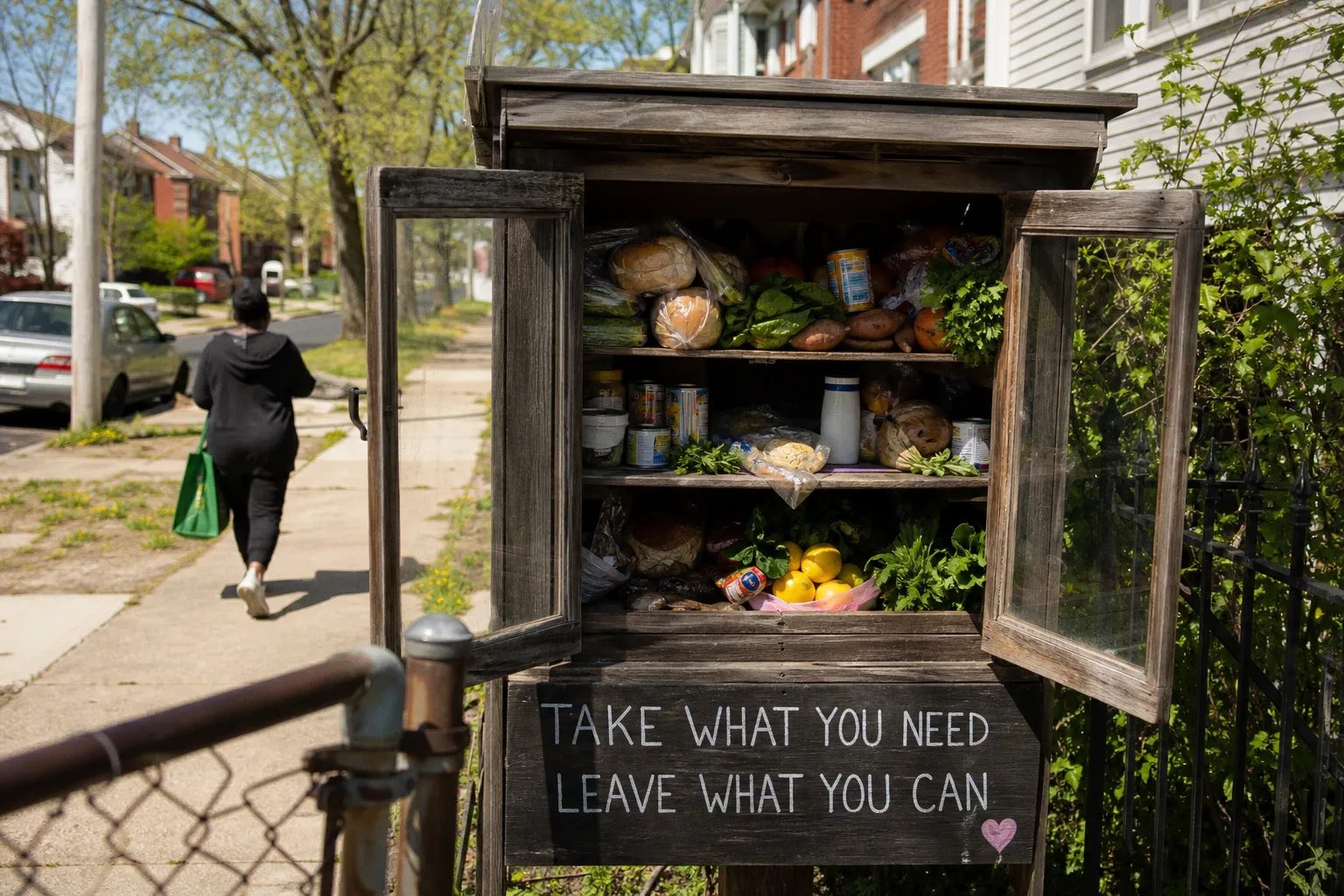
What grew in the rubble was something the political class hadn't budgeted for. By April 2020, a single online registry was tracking more than 800 mutual aid networks across the country — grocery deliveries coordinated through group chats, rent pools organized on Signal, community fridges stocked by neighbors who had never met before the pandemic. No board of directors. No federal funding stream. No press secretary. Just people deciding, in real time, that if the state was not coming, the state was not coming, and the groceries had to get up the stairs anyway.
That scaling shock is the entry point for any honest answer to the question: what is mutual aid, and why is it suddenly everywhere?
The Philosophical Roots: Cooperation as a Load-Bearing Wall
The framework most people now call "mutual aid" has a longer paper trail than its viral resurgence suggests. In 1902, the Russian anarchist theorist Peter Kropotkin published Mutual Aid: A Factor of Evolution as a direct rebuttal to the Social Darwinist doctrine then taking hold in European and American intellectual life. Where Thomas Huxley and his acolytes insisted that nature rewarded ruthless competition, Kropotkin pointed at the empirical record: species that cooperate, from ants to humans, outcompete the ones that don't. Cooperation, he argued, was not a moral luxury. It was a survival mechanism embedded in the biology of every successful community.
Mutual aid is older than the nation-state, older than the charity industrial complex, and older than every politician who has ever claimed it as proof that the market works.
That text landed inside an already-active labor tradition. The Knights of Labor, the Industrial Workers of the World, the mutual benefit societies that flourished in Black communities excluded from white craft unions — all built survival infrastructure on the same horizontal premise long before anyone put the word "solidarity" on a tote bag. Survival programs run out of Oakland by the Black Panther Party in the late 1960s ran free breakfast for thousands of children every morning, on the explicit logic that the state had forfeited its legitimacy by denying people what they needed to live. That lineage matters. Mutual aid is not a 2020 invention that broke containment. It is a centuries-old infrastructure that the formal economy has repeatedly tried to erase, fund, co-opt, or rebrand.
Solidarity, Not Charity: The Power Dynamic That Distinguishes Them
Most of the confusion around mutual aid collapses into one word: charity. The two are not adjacent, and they are not interchangeable. They are oppositional structures.
Charity is vertical. A donor — individual, foundation, corporation — sits above a recipient. The donor defines the problem, selects the solution, controls the resources, and walks away with the moral reward of having "helped." The recipient has no obligation to the donor and no power over the donor. In economic terms, charity extracts from the giver a feeling of virtue and from the receiver a position of deficit. It does this while leaving intact every material condition that produced the need in the first place. This is why corporate philanthropy has never produced systemic change and was never structurally equipped to. The CEO cutting a giant novelty check is performing a tax optimization, not restructuring wealth.
Mutual aid is horizontal. Aid flows inside a network of equals. Money, food, labor, and information circulate because each participant knows the same catastrophe can land on their stoop tomorrow, and often already has. The aid relationship does not elevate the giver, and it does not stigmatize the receiver. It treats need as a shared material condition and response as a collective project. The principle is often summarized in three words — solidarity, not charity — and that compressed formulation gets more right than most academic papers on the subject.
| Dimension | Charity | Mutual Aid |
|---|---|---|
| Direction of aid | Top-down: donor to recipient | Lateral: network of equals |
| Decision-making power | Concentrated in donor or funder | Distributed among participants |
| Stigma of receipt | Built in (means-testing, vetting) | Reframed as a shared material condition |
| Accountability | To donors, board, or grant cycle | To the community being served |
| Structural effect | Leaves root causes intact | Builds infrastructure that bypasses them |
| Political function | Moral cover for systemic abandonment | Direct practice of collective survival |
That distinction is not semantic. It determines what gets built. A food bank built on charity logistics will ask whether you have a referral, whether you live in the right ZIP code, and whether you can come back Friday between 10 and 2. A mutual aid pantry will leave food on your porch, ask for nothing, and check on you again next week.
Decentralized Resilience: How the Networks Actually Function
Strip away the political theory and mutual aid is, before anything else, a logistics operation. The whole point is that it works.
The mechanical core is simple. A group of neighbors — sometimes dozens, sometimes thousands — pools knowledge about who needs what, who has what, and who can move it. Communication runs through whatever tools survive: group texts, WhatsApp threads, encrypted Signal channels, public spreadsheets, hyperlocal subreddits, Nextdoor posts that escape the platform's reputation for surveillance-grade snitchery. A coordinator — rarely a single permanent one — aggregates asks, matches them against offers, and keeps the loop closed so the wheel doesn't spin.
What this gives a community is something no agency in Washington can deliver at neighborhood scale: rapid information. The federal emergency management apparatus is built around aggregating damage assessments after the event has already torn through. A functioning mutual aid network has a head start because the sensors are the residents. They know which house has a wheelchair user on the third floor and no power. They know which neighbor just lost a job. They know which street floods first. That data is impossible to buy and impossible to centralize.
Voluntary informal status is a feature, not a bug. Many mutual aid groups deliberately avoid incorporating as 501(c)(3) nonprofits, because incorporation means a board, bylaws, fiduciary duties to a funder, and reporting requirements that pull labor away from the actual work. They don't have an executive director. They don't apply for grants on a quarterly cycle. They don't measure success by the metrics their donors want to see. They can pivot in an afternoon because no one has to call the funders for permission.
The result is what organizers call rapid response capacity. When a heat dome settles over a city without AC, the mutual aid network already knows which buildings have vulnerable residents. When a rent strike starts, the network already knows who can cover a groceries gap. When a family gets evicted at midnight, the network already has a phone tree and a U-Haul on standby. That kind of speed is structurally unavailable to institutions that have to clear every line item with a contract officer.
Crisis Response: Why Mutual Aid Surges Every Time the State Fails
The pattern is consistent enough to name. Every major breakdown in the official aid apparatus produces a measurable spike in mutual aid activity. The COVID-19 pandemic produced one. Hurricane Maria, where the federal response was so delayed and politicized that Puerto Rican communities organized their own supply chains by necessity, produced another. Hurricane Katrina, the Texas grid failure of 2021, the Maui fires of 2023, the long recovery from the Co-
win tornado outbreak — each time, the same thing happens: official channels slow down, get conditional, or get weaponized, and neighbors pick up the slack.
Why? Because the institutional architecture is the limiting factor. FEMA reimburses at the speed of paperwork. State emergency funds release when governors declare, which happens when politically useful. Private disaster nonprofits triage by what their donor base finds photogenic. Wealthy zip codes recover faster than poor ones inside every disaster the country has officially measured, a fact the federal data confirms in its own dry language.
The state does not respond to disaster. The state responds to disaster politics. Mutual aid responds to disaster.
Climate change is going to make this pattern worse, and the math is brutal. As warming intensifies, climate disasters are happening at a higher frequency, reaching further into communities, and overlapping in ways that burn out the volunteer base even as the need intensifies. Mutual aid networks are not magic. They run on people, and people burn out. There are real scaling ceilings to informal infrastructure. Anyone pretending otherwise has never tried to organize a grocery delivery operation across a city for two months on fumes.
Which is precisely why the relevant question is not whether mutual aid works. It works. The relevant question is why we have organized the economy so that it must.
Maintaining Autonomy: Why Informality Is a Strategic Choice
The resistance to formalization inside mutual aid networks is often misunderstood as political naivete. It is not. It is a calculation.
Becoming a nonprofit means accepting state oversight. It means filing IRS forms, maintaining board minutes, defending an executive compensation structure, and accepting grant terms that frequently prohibit exactly the kind of direct action — eviction defense, fare-free transit, mutual bail — that the political instinct of mutual aid points toward. The state regulates nonprofits because the state wants to control where relief money flows and what it can be spent on. Many groups have decided, correctly, that they would rather not be on that leash.
The state would also like to manage mutual aid more directly than it currently does. Federal and philanthropic funders have spent the past several years trying to "professionalize" mutual aid networks with grants and infrastructure — language of capacity building, technical assistance, sustainability planning. The polite term for this is scaling. The structural term for it is depoliticization. A mutual aid network that is dependent on foundation money for its operational budget stops being a horizontal project that can refuse the local mayor's eviction regime, and starts being a service provider that has to play nice with the office of housing to keep the lights on.
Some groups have taken foundation money and navigated the tradeoffs transparently. Some have refused and built sustainable funding through member dues, small-dollar donations, rotating fund pools, and labor solidarity. Neither model is pure. Both work better than pretending the choice does not exist.
What the state cannot easily replicate — and what it cannot easily surveil — is the trust infrastructure that mutual aid networks actually run on. That trust is built door to door, distribution by distribution, ride by ride. It is not a deliverable. It is a practice. And it is precisely the kind of activity that gets harder, not easier, the more it gets funded from above.
What Mutual Aid Is, in the End
Strip the framework down to one sentence and it reads like this: mutual aid is the practice of meeting collective need through horizontal coordination without permission, without conditionality, and without the leverage of capital.
It is not a substitute for state capacity. Anyone who has organized a major mutual aid operation will tell you, between your third and fourth all-nighter, that it should not have to be the substitute for state capacity. The same government that can find $886 billion for a defense budget can find the money to feed the people it abandoned during a pandemic. That this is even a debate is a measure of how successfully wealth has captured the political system.
But until that system is forced to disgorge the resources it has hoarded, the people who do not want to wait — who never wanted to wait — will keep building the infrastructure the state refuses to. That is what mutual aid is. It is the organized refusal to treat material need as a matter of personal luck. It is what solidarity looks like when the institutions have walked away from the work.
The question worth sitting with, the one this whole resurgence is finally forcing, is not whether mutual aid works. It does. The question is whether we are going to keep letting the state off the hook for the conditions that require it to exist in the first place.